
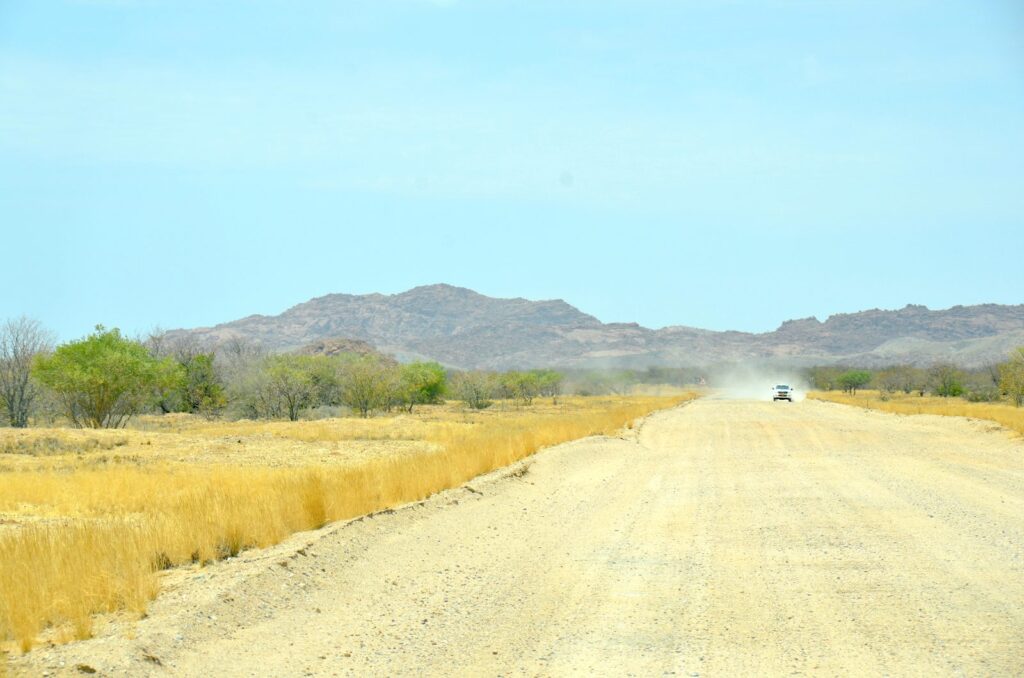
Namibia is a country you experience mostly through a windscreen. The distances are long, the population is thin, and the things worth seeing are a long way apart — which means the driving is not the boring part between destinations, it is a substantial share of the trip. Most people who have a difficult time in Namibia have a difficult time on the roads, and almost always for the same handful of reasons.
This is what to expect, and what actually causes trouble.
The road network in plain terms
Namibian roads are lettered, and the letter tells you most of what you need to know.
B roads are the tarred national routes — the B1 running north–south through Windhoek, the B2 out to the coast, and so on. They are good roads by any standard, and you can cover ground on them quickly.
C roads are the main secondary routes and are mostly gravel. Many are wide, graded and perfectly comfortable at a sensible speed. This is the surface most of your touring will happen on.
D roads are minor district roads, also gravel, and far more variable. Some are fine. Some are rough, narrow, sandy or badly corrugated, and a few are genuinely demanding. Condition is not predictable from the number.
A route that looks short on a map can take twice as long as you expect if most of it is D road. Our Namibia driving distances table gives realistic figures for the main legs.
Gravel is the whole game
If you take one thing away, take this: the overwhelming majority of serious accidents involving visitors happen on gravel, and the cause is speed. Gravel behaves nothing like tar. The surface moves under you, the loose material collects in the middle and at the edges, and grip disappears without warning at exactly the moment you need it — a sudden correction, a blind rise, an animal.
The characteristic Namibian crash is a single-vehicle rollover: a driver going too fast for the surface makes a sharp input, the vehicle steps out, they overcorrect, and it goes over. It happens to competent drivers who simply carried tar-road habits onto gravel.
Many rental agreements specify a maximum speed on gravel, commonly around 80 km/h, and some make cover conditional on it. Read your contract rather than assuming. In practice, slower than the limit is often the right answer anyway — corrugation, a soft verge or a fresh grading can all mean the sensible speed is well below what the road seems to invite.
Tyres will be your most likely problem
Punctures and sidewall cuts are far and away the most common mechanical issue on a Namibian self-drive, and gravel is unkind to tyres in a way tar simply is not. Sharp stone edges cut sidewalls; underinflated tyres pick up damage on corrugation.
Before you leave the rental depot, physically check that the spare is present, inflated and matched, and that the jack and wheel brace are actually in the vehicle. Do not take this on trust. For remote routes — the Kunene, parts of Damaraland, the far south — two spares is a reasonable precaution rather than paranoia, and many operators will supply a second on request.
If you have never changed a wheel, learn before you go. You may be a long way from anyone who can do it for you.
Fuel: plan by station, not by distance
The mistake is thinking about range. The right way to think about it is: where is the next fuel station I am confident is open and has fuel? On the main tarred routes this is rarely an issue. Off them it is a real planning constraint, and in places like Kamanjab, Opuwo or Solitaire the sensible habit is to fill whenever you pass a working pump, regardless of what the gauge says.
Carry some cash. Card systems at remote stations are not always working, and a station that cannot take your card is functionally a station with no fuel.
Animals on the road
This is the other major cause of accidents. Warthog, kudu, oryx and springbok all cross roads, and kudu are the genuinely dangerous ones — they are large, they jump, and a startled kudu can come through a windscreen. On communal land there is often no fencing at all, and cattle, goats and donkeys stand on and beside the road.
The practical consequence is dawn, dusk and night. Animals are most active exactly when your visibility is worst.
Do not drive at night
This is the closest thing to a rule that experienced Namibia travellers agree on. Unlit roads, unfenced livestock, wildlife, the occasional unmarked hazard and long distances from help combine badly. Plan your days so you arrive before dark, and build in slack — a puncture at four in the afternoon should not force you into two hours of night driving.
In practice this shortens your usable driving day considerably in winter, when it is dark by around half past six. Factor that in when you plan legs.
The coast is its own problem
The salt roads along the coast, including the route north from Swakopmund towards Henties Bay and the Skeleton Coast, are compacted salt rather than gravel. In dry conditions they are excellent — smooth and fast. In fog or after damp, they can become genuinely slippery, and the coastal fog here is frequent rather than exceptional. Slow down when the surface looks dark or greasy.
Rain changes everything
Namibia’s rain is seasonal and mostly falls in the summer months. When it comes, gravel roads deteriorate quickly, and normally dry riverbeds — the ones you cross on concrete causeways without thinking — can run hard and fast for a few hours.
The rule for a flowing crossing is simple: do not. Water depth and current are extremely hard to judge, the surface underneath may have washed out, and these floods usually drop within hours. Wait. If you are travelling in the wet months, ask locally about road conditions rather than relying on a map, and read our best time to visit Namibia guide for the seasonal picture.
Read your rental contract properly
Namibian rental agreements routinely contain restrictions that matter: excluded roads or regions, rules about border crossings into neighbouring countries, gravel speed conditions, and — most importantly — how single-vehicle rollover and tyre or windscreen damage are treated. Rollover excess is often high and is often the one thing not covered by the standard waiver.
Understand what you are and are not covered for before you sign, not after something happens 300 kilometres from the nearest town.
Connectivity and telling someone where you are
Mobile coverage is good in towns and along the main tarred routes, and thins fast off them. In parts of the Kunene and the far south you should assume no signal for extended stretches.
The practical answer is not technology, it is habit: tell your accommodation where you are heading and roughly when you expect to arrive. In a country this empty, someone knowing your intended route is worth more than a signal bar.
What this adds up to
None of this makes Namibia difficult to drive. It is, for the most part, a straightforward and enormously enjoyable country to travel by road, with light traffic and extraordinary scenery. But it is unforgiving of the specific habits that work fine elsewhere — driving fast on loose surfaces, pushing on after dark, treating fuel as a range calculation, and assuming a rental car comes with a usable spare.
Get those four right and most of the risk disappears. Our Namibia self-drive mistakes to avoid covers the planning errors that compound them, self-drive Namibia sets out the practicalities, and if you are still deciding what to hire, the question of what vehicle you actually need is worth working through before you book.
Frequently asked questions
Is it safe to drive in Namibia?
Yes, with the caveats above. Traffic volumes are low and the main roads are good. The risks are specific and manageable: speed on gravel, animals, night driving and long distances between services.
How far can I realistically drive in a day?
On tar, a lot. On gravel, plan conservatively — average speeds are much lower than the map suggests, and arriving before dark should govern the plan rather than the distance.
Do I need to carry water?
Yes, always, and more than you think. A breakdown on a quiet D road in summer is a heat problem before it is a mechanical one.