
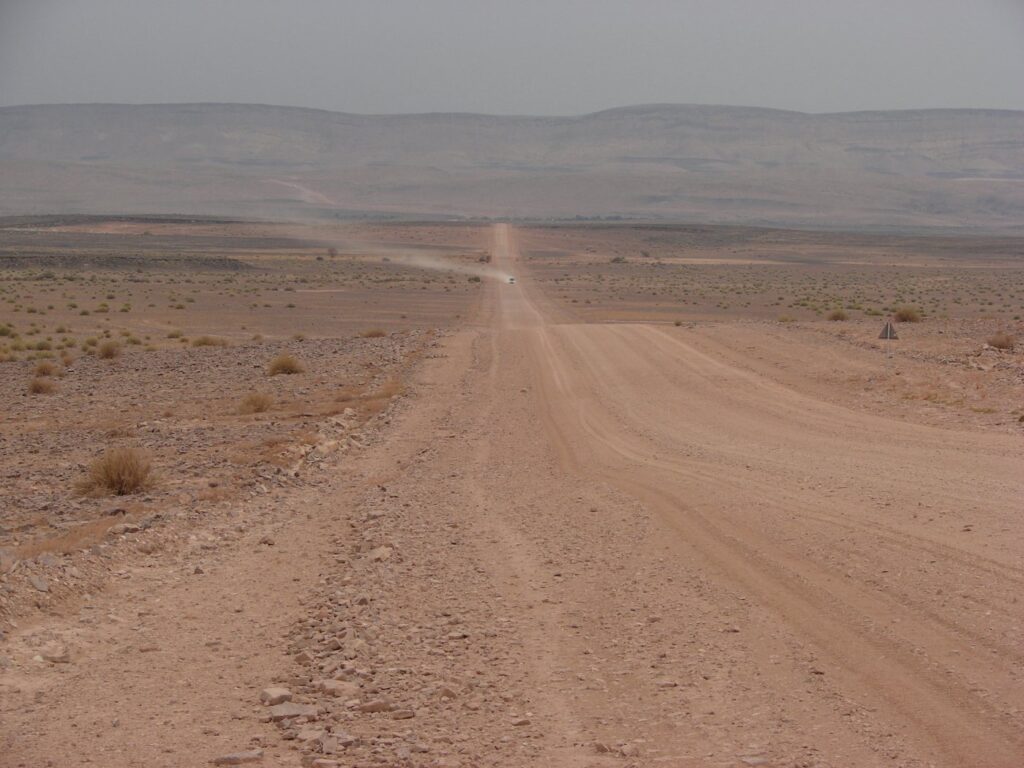
Namibia rewards the drive more than almost anywhere else. The distances are long, the traffic is negligible, and the landscape changes character every couple of hours. What follows are the roads worth building a route around rather than simply passing through — and, just as usefully, the ones that ask more of your vehicle and your nerve than the guidebook photograph suggests.
The C14 over the Kuiseb and Gaub passes
The C14 runs inland from Walvis Bay towards Solitaire, and it is the drive that converts people. You leave the cold coastal fog, climb through the flat gravel plains of the Namib-Naukluft, and then drop into the Kuiseb canyon — a sudden, deep cut in what looked like featureless ground. The Gaub Pass follows soon after. Both are gravel, both are graded, and neither needs a 4×4 in normal conditions. Allow far longer than the distance implies, because you will stop.
The D707 along the Nubib mountains
The D707 is the road most Namibian self-drivers name first. It runs south from the Sesriem area between the Tiras Mountains and the dune fields, with red sand on one side and dark rock on the other for something like 120 kilometres. There is essentially nothing on it: no fuel, no settlements, very little traffic. That emptiness is the attraction and also the reason to treat it seriously — carry water, start with a full tank, and do not plan to drive it at the end of a long day.
Spreetshoogte Pass
Spreetshoogte drops off the central plateau to the desert floor in a very short distance, and it is the steepest pass in Namibia. Driven westbound, the view opens all at once at the top and the descent does the rest. It is not technically difficult in a normal vehicle in dry conditions, but it is steep enough that overheating brakes are a real consideration in a heavy, fully loaded car. Descend in low gear rather than riding the pedal.
The C34 up the Skeleton Coast
North of Swakopmund the C34 runs on salt road between the Atlantic and the gravel plains, past shipwrecks, seal colonies and almost no vegetation at all. It is a completely different kind of scenic: bleak rather than beautiful, and better for it. The salt surface is fast and smooth when dry and genuinely slippery in fog, which is common here in the mornings. See our Skeleton Coast page for what is accessible without a permit.
Khorixas to Twyfelfontein and on to Palmwag
This stretch through Damaraland is the drive that makes the region make sense. Flat-topped mesas, basalt, and the occasional desert-adapted elephant crossing a dry riverbed. The C39 and D2612 towards Twyfelfontein are gravel and generally fine; the tracks beyond Palmwag are a different proposition and are where high clearance stops being optional.
The B4 from Keetmanshoop to Lüderitz
Tarred the whole way and often dismissed as a transit road, the B4 is quietly one of the best drives in the south. It starts at Keetmanshoop, the obvious overnight stop before the run west. The last hour past Aus runs through open desert where the feral horses are sometimes visible from the road, and the light in the late afternoon is extraordinary. It ends at Lüderitz, which is worth more than the single night most itineraries give it.
What these roads actually ask of you
Almost all of Namibia’s scenic driving is on gravel, and gravel is where most visitor accidents happen. The pattern is consistent: too fast, a sudden correction, a rollover. Sixty to eighty kilometres per hour is the sensible range on a good gravel surface, less on corrugations and sand. Tyres matter more than the vehicle — two spares is normal practice here, not paranoia.
Plan fuel by the map rather than by the gauge. Our guide to fuel planning in Namibia covers the stretches where the gap between stations is longer than people expect, and Namibia driving distances gives realistic times rather than optimistic ones. For the broader picture of hiring and driving your own vehicle, start with self-drive in Namibia, and read is Namibia safe for the road-specific risks that matter most.
Two roads to think twice about
Van Zyl’s Pass in the far north-west is a genuine 4×4 route, one-way westbound, and not something to attempt in a single vehicle or without recovery gear and experience. The Naukluft 4×4 trail is similar in character. Both appear on scenic-drive lists written by people who did them in a convoy with a guide. If your trip is a hired 2WD or a soft-roader, the drives above will give you the same landscapes without the risk.
Timing matters more than the route
The same road is a different drive at different hours. Namibian light is hard and flat between about ten and four, and the landscapes that photograph so well are mostly doing it in the first and last ninety minutes of daylight. That argues for short driving days with early starts rather than long ones — and it fits the other constraint, which is that you should not be driving after dark. Warthog, kudu and cattle all use the road at dusk, and a kudu through the windscreen is the single most common serious accident involving visitors.
Season changes the surface more than the scenery. Between roughly December and March, rain can cut gravel roads and make river crossings impassable for hours or days; the desert roads in the south are the last to be affected and the first to recover. From May to September the surfaces are at their best and the light is cleanest, which is also why Sossusvlei and the passes inland from Swakopmund are busiest then.
Where to break these drives
Most of the routes on this page are too long to do without an overnight. These three sit on the classic scenic legs — the Solitaire road, the coast and the Etosha gate roads.
Places to stay near Namibia
Solitaire Roadhouse
Solitaire is a fuel stop, a bakery and a scatter of buildings at the junction of the C14 and C19, and it has become…
Price Guide: N$2,663
View Property DetailsSea Wind Self Catering Cottages Swakopmund
Sea Wind Self Catering Cottages Swakopmund is a 5-minute drive from Ocean View Shopping Centre, with Platz am Meer…
Price Guide: N$1,250
View Property DetailsEtosha Trading Post Campsite
Etosha Trading Post Campsite sits on the southern approach to Etosha, within convenient reach of the Andersson…
Price Guide: N$585
View Property Details
Building a route around them
Two of these drives fit almost any Namibia itinerary without adding days: the C14 sits naturally between the coast and the desert, and the Khorixas–Twyfelfontein stretch is already on the way north to Etosha. The D707 and the B4 to Lüderitz are the ones that cost you time, and both are worth it if you have two weeks rather than ten days. If you are still shaping the trip, the itinerary pages are the quickest way to see where each of these fits.
Several of these routes connect to South Africa or Botswana. If yours does, crossing the border into Namibia by car covers what the vehicle desk will ask for.