
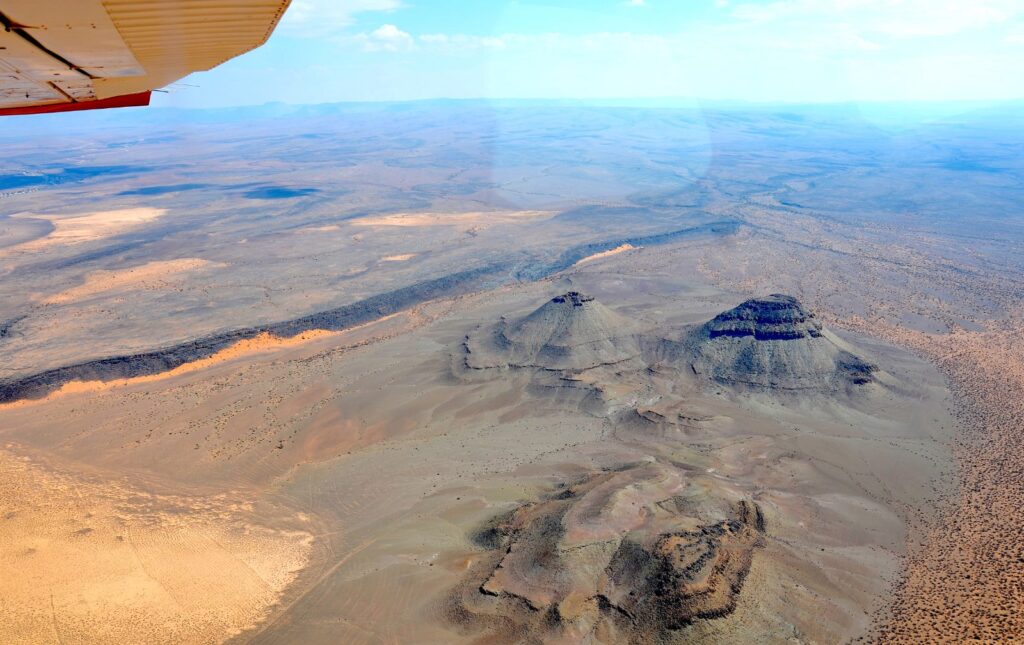
Namibia has a reputation as one of the more straightforward African countries to travel independently, and that reputation is broadly deserved. Traffic is light, the tourism infrastructure works, and most visitors have an entirely uneventful trip. But the risks that do exist are specific, and they are not the ones people usually worry about before they arrive.
The single most useful thing to understand is this: in Namibia, the road is the risk. Almost everything else is secondary.
Road safety comes first, by a wide margin
The characteristic serious incident involving visitors is a single-vehicle rollover on gravel. It happens to competent drivers who carry tarred-road habits onto a loose surface, make one sharp input, and lose the back of the car. It is not exotic and it is not bad luck — it is a predictable consequence of speed on gravel.
Everything else about road safety here follows from that: keep your speed down on gravel, do not overcorrect if the car steps out, and treat every blind rise as though something is on the other side. Our driving in Namibia guide covers the road types and conditions in detail, and self-drive mistakes to avoid covers the planning errors that lead to rushed driving in the first place.
Fatigue and distance
Namibian driving days are long, the landscape is hypnotic, and there is very little traffic to keep you alert. Fatigue creeps up faster here than most people expect. Break the drive, swap drivers if you have a second one, and resist the temptation to add one more leg because the map makes it look short.
Plan to arrive before dark. This is the most valuable single habit you can adopt, and it also solves several other problems at once.
Do not drive after dark
Unlit roads, unfenced livestock, wildlife, long distances from help and the occasional unmarked hazard combine badly. Kudu in particular are large, jump when startled, and are most active at dawn and dusk. On communal land, cattle, goats and donkeys stand on and beside the road with no fencing at all.
If you are running late, it is almost always better to stop somewhere unplanned than to push on in the dark.
Tyres, breakdowns and being self-sufficient
Punctures and sidewall cuts are the most common mechanical problem on a Namibian trip. Before leaving the rental depot, physically check that the spare is present, inflated and matched, and that the jack and brace are in the vehicle. If you have never changed a wheel, learn before you go — you may be a long way from anyone who can do it for you.
Carry more water than you think you need. A breakdown on a quiet gravel road in summer becomes a heat problem long before it becomes a mechanical one. Take food, sun protection and something warm for after dark.
Communications and telling someone your route
Mobile coverage is good in towns and along the main tarred routes and thins quickly off them. In parts of the Kunene and the far south, assume no signal for extended stretches.
The practical protection is not technology but habit: tell your accommodation where you are going and roughly when you expect to arrive. In a country this empty, someone knowing your intended route is worth more than a signal bar. For genuinely remote routes, travelling in two vehicles is a common and sensible precaution.
Wildlife
Namibia’s wildlife risk to visitors is overwhelmingly about vehicles rather than encounters. That said, the ordinary rules apply where game is present: stay in your vehicle inside national parks, keep a real distance from elephant and never position yourself between a herd and water, and do not approach animals on foot in unfenced areas.
In the north-east, elephant are present along roads including main routes — another reason night driving is discouraged there in particular. Do not swim or wade in the Kunene, Okavango or Zambezi: crocodiles and hippo are both present.
Towns and personal security
Namibia’s towns are generally relaxed, and most visitors experience no difficulty at all. The sensible precautions are the ordinary ones for any unfamiliar place: do not leave valuables visible in a parked vehicle, be more careful after dark in urban areas, use ATMs inside banks or malls rather than on the street, and do not walk alone at night in parts of town you do not know.
A loaded self-drive vehicle is the most obvious target you present. Keep luggage out of sight, and do not leave cameras or bags on seats while you stop for lunch.
Money and documents
Carry some cash. Card systems at remote fuel stations are not always working, and a station that cannot take your card is a station with no fuel as far as you are concerned. Keep a photograph or copy of your passport and driving licence separately from the originals.
Health and insurance
Medical facilities are good in Windhoek and adequate in the larger towns, and thin to non-existent in remote areas. Given how far you may be from help, comprehensive travel insurance that covers medical evacuation is worth treating as non-optional rather than as an upsell.
Discuss malaria precautions with a travel health professional before you go — risk varies considerably by region and season, and is concentrated in the north and north-east. Take sun protection seriously; the combination of altitude, dry air and clear skies burns people who thought they were being careful.
What this adds up to
If you drive at a sensible speed on gravel, arrive before dark, check your spare tyre, carry water and tell someone your route, you have addressed the great majority of the real risk of travelling in Namibia. The rest is ordinary travel sense.
For trip planning, see our Namibia itineraries and best time to visit Namibia; for what to bring, the Namibia packing list.
Frequently asked questions
Is Namibia safe for tourists?
For most visitors, yes. Traffic is light, the tourism infrastructure is well established, and violent crime against tourists is not a typical experience. The genuine risks are road accidents, fatigue and remoteness rather than crime.
Is it safe to self-drive in Namibia?
Yes, and it is how most visitors travel. The conditions that cause trouble are specific and avoidable: excessive speed on gravel, driving after dark, and setting out without a usable spare tyre or enough water.
Is it safe to drive at night?
It is strongly discouraged. Unlit roads, unfenced livestock and active wildlife make night driving disproportionately risky, and help can be a long way away.
Do I need travel insurance?
Treat it as essential rather than optional, and check that it covers medical evacuation. Much of the country is a long way from a hospital.
For the other side of the same subject — which Namibian roads are worth driving for their own sake, and which ones deserve more caution than their reputation suggests — see the best scenic drives in Namibia.
Much of the safety advice above assumes you cannot simply phone for help, which for large parts of Namibia is accurate. SIM cards and connectivity in Namibia sets out exactly where the network runs out.