
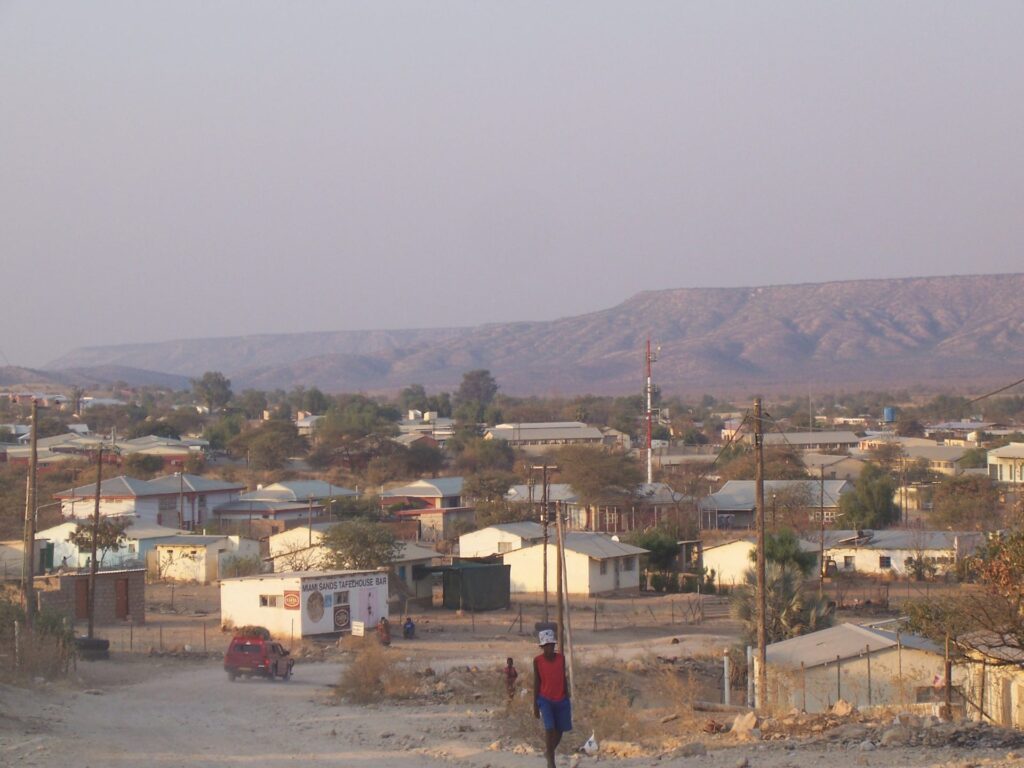
Namibia is the second least densely populated country on earth, and its mobile network reflects that. Coverage in the towns is genuinely good; coverage across the enormous spaces between them is not, and no SIM card will change that. The useful question is not “will I have signal?” but “where will I not, and what should I do about it?”
The networks
MTC is the dominant operator with roughly 80% of the market and by some distance the broadest rural reach. If you buy one SIM, buy this one. TN Mobile (Telecom Namibia) is the state-backed alternative, with respectable coverage in the far north but thinner reach elsewhere. Paratus exists but is oriented to fixed wireless and business connectivity rather than tourist SIMs.
In Windhoek, Swakopmund and Walvis Bay you can expect ordinary 4G at something like 15–40 Mbps. That is enough for maps, messaging, video calls and uploading photographs without thinking about it.
Where there is no signal
The honest list is long. Damaraland, the Skeleton Coast and the dune country around Sossusvlei range from 2G to nothing. Kaokoland and the deep desert are largely offline. Long stretches of the Zambezi region and the roads through it drop out for hours at a time.
Inside Etosha, MTC reaches patchily around the main rest camps and disappears on game drives. This is worth internalising before you rely on a phone for anything time-critical: for large parts of a normal Namibian itinerary you are out of contact, and that is the normal condition rather than a fault.
Buying a local SIM
Namibia requires SIM registration, so bring your passport. Registration at an MTC or TN Mobile kiosk takes roughly ten to fifteen minutes and is done on the spot. Kiosks are at Hosea Kutako International Airport, in the Windhoek malls, and in every town of size.
A tourist data bundle of 5–10 GB valid for about a week runs in the region of N$100–200 on MTC. For the length of most Namibia trips that is enough, and it is markedly cheaper per gigabyte than roaming or an eSIM. Top-up airtime is sold everywhere, including at fuel stations and small shops.
eSIM, or a local SIM?
eSIMs from the usual international providers do work in Namibia and are convenient if your phone supports one and you would rather not queue at a kiosk. They ride on the same physical networks, so they will not give you coverage where MTC has none — the map is the map. They cost noticeably more per gigabyte than a local prepaid bundle.
The reasonable split: if you are in Namibia for under a week and mostly in towns, an eSIM is the path of least friction. For a two- or three-week self-drive, a local MTC SIM is better value and has the better rural footprint.
Lodge wifi
Wifi is widespread at lodges, guest farms and cafés, and is often the only connectivity you will have for a day at a time. Two caveats. First, satellite-backed lodge wifi in remote areas can be slow and is frequently capped or restricted to the main building — it is for messages, not for streaming. Second, these are open or shared-password networks, so treat them accordingly: no banking, and use a VPN if you are working.
What to do about the gaps
Download offline maps before you leave a town with signal. This is the single most useful habit in Namibia. Offline Google Maps or an offline-first app such as maps.me will navigate you across regions where you will not see a bar for hours.
Tell someone your route. On the remote gravel stretches described in our scenic drives guide, a breakdown means waiting for another vehicle rather than calling for help. That is also why our Namibia safety guide treats water and a second spare tyre as route planning rather than paranoia.
Book and confirm accommodation while you have signal. Lodge phone lines in remote areas can be satellite-dependent and are not always answered, and arriving unbooked at a lodge that is full is a long drive to the next option.
Finally, do not fight it. A large part of what people come to Namibia for is exactly the emptiness that keeps the network out. Plan for the gaps, download what you need, and let the rest go.
A realistic connectivity plan by region
Windhoek, Swakopmund, Walvis Bay: full 4G, no planning required. The B1 corridor and the main towns — Otjiwarongo, Tsumeb, Grootfontein, Keetmanshoop, Mariental, Rundu: reliable signal in town, intermittent between them. Etosha: assume nothing on drives, something at the camps. Sossusvlei and Solitaire: lodge wifi only. Damaraland, Kaokoland, the Skeleton Coast: plan to be offline.
None of this is a reason to skip a local SIM. Even patchy coverage is worth having when you need to phone ahead about a late arrival, and the cost is trivial against what the trip is already costing you. It is simply worth arriving with the right expectation rather than discovering it somewhere north of Palmwag.