
There is no honest single number for what a Namibia trip costs, and anyone who gives you one is either guessing or selling something. What there is, is a small set of decisions that between them account for most of the variation — and once you understand those, you can build a realistic figure for the trip you actually want rather than an average trip nobody takes.
This guide deliberately avoids quoting specific prices. Rates move, the exchange rate moves, and a figure published today is misleading within a season. What does not change is the structure of the spending.
The four decisions that set your budget
In rough order of impact:
1. Camping or lodges. This is the single biggest lever, and the gap between the two is very large. Camping in Namibia is well set up, with good facilities in most places, and it changes your nightly cost by an order of magnitude compared with mid-range lodges. Many travellers mix the two — camping through the cheaper stretches, lodges where it matters.
2. Vehicle. Your second-largest fixed cost, and one you commit to before you leave. A standard car, a high-clearance 2WD, a 4×4 and a fully equipped camping bakkie are four quite different price points. See 4×4 vs 2WD in Namibia before you assume you need the top of that range — a lot of people over-specify.
3. Trip length and route shape. Longer trips cost more in total but often less per day, because the fixed costs spread. A tightly packed route also burns significantly more fuel than a relaxed one covering fewer regions.
4. Group size. Namibia rewards couples and small groups heavily. The vehicle, which is one of your two biggest costs, is the same price for one person as for four. Solo travel here is proportionally expensive in a way it is not in countries with good public transport or a hostel circuit.
Fuel deserves its own line
People routinely underestimate fuel, because they underestimate the distances. Namibia is large and the interesting places are far apart — a two-week self-drive covers a lot of ground, and fuel becomes a serious line item rather than an afterthought.
Estimate it properly rather than guessing: take your intended route, add up the legs using our Namibia driving distances table, add a margin for detours and game drives, and apply your vehicle’s realistic consumption. A big 4×4 on gravel does not return its brochure figure. Game driving in Etosha in particular burns a lot of fuel for very few kilometres of progress.
Park fees and permits
Namibia’s national parks charge daily entry per person plus a vehicle fee, and rates differ for foreign visitors, residents and citizens. Some sites — Kolmanskop among them — involve a separate permit or tour booking.
These are real but generally modest against your accommodation and vehicle costs. Budget for them rather than being surprised by them, and check current rates with the relevant park authority when you plan, since published figures date quickly.
Food and drink
Self-catering is straightforward. Supermarkets in Windhoek, Swakopmund and the larger towns are well stocked, and if you are camping you will be buying most of your food this way. Stock up in the bigger towns rather than relying on village shops, where range is limited and prices are higher.
Restaurant eating varies enormously — a town café and a lodge dining room are not in the same bracket. If you are on a full-board lodge itinerary, much of this is already inside your accommodation cost, which is part of why those trips look expensive on paper and then involve less incremental spending.
Activities are the elastic part
This is where two people on identical routes end up with very different totals. Balloon flights over the Namib, scenic flights over the Skeleton Coast, guided dune excursions, catamaran trips at Walvis Bay, guided game drives and rhino tracking are all optional, and several of them are individually significant.
None of them are necessary to have an excellent trip — Namibia’s headline experiences are largely landscape and wildlife you can reach yourself. But a couple of the bigger activities can move your budget noticeably, so decide which ones matter to you in advance rather than booking them ad hoc.
What is usually not in the number
International flights are normally quoted separately and vary far too much by origin and season to generalise about. Travel insurance is worth treating as non-optional given the remoteness of much of the country. And rental excess — particularly for rollover, tyres and windscreens — is a real potential cost that people forget to think about until it applies.
Three broad shapes of trip
Rather than numbers, it helps to think in shapes.
Camping self-drive. The lowest cost per day by a wide margin. Vehicle plus fuel dominates; nightly costs are small. Best value for travellers with time and an appetite for setting up camp every night.
Mid-range lodge and guesthouse self-drive. The most common shape. Accommodation becomes the largest line, vehicle and fuel next, activities selective. This is the trip most first-time visitors take.
Fly-in or high-end lodge. A different category entirely, where accommodation and internal flights dominate and the vehicle question largely disappears. Fewer days, less driving, much higher daily cost.
How to build your own estimate
Work in this order and you will get a figure you can trust: choose the trip length and route, price the vehicle for that duration, estimate fuel from the actual legs, decide your accommodation style and count the nights, add park fees per person per day, add a food allowance based on how much you will self-cater, then add the specific activities you have decided you want. Finally add a genuine contingency — a spare tyre, an unplanned night, a change of route.
Start from the Namibia itineraries to fix the route and length, and read best time to visit Namibia before you commit to dates, since season affects both prices and availability.
What a night actually costs
Accommodation is the largest single line in most Namibia budgets. These three show the real spread across the country — a campsite, a mid-range lodge and a desert lodge — using the price guides we maintain from dated checks rather than headline rates.
Places to stay near Namibia
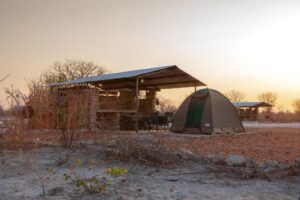
Etosha Trading Post Campsite
Etosha Trading Post Campsite sits on the southern approach to Etosha, within convenient reach of the Andersson…
Price Guide: N$585
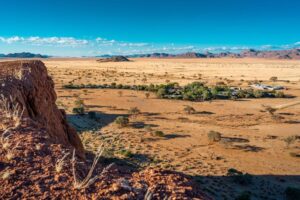
View Property DetailsGondwana Namib Desert Lodge
Gondwana Namib Desert Lodge is built against a wall of fossilised dunes north of Sesriem, and that backdrop is the…
Price Guide: N$5,084
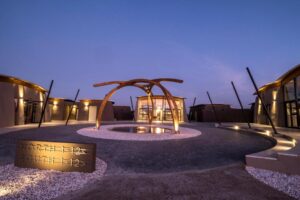
View Property DetailsThe Desert Grace
The Desert Grace sits on the corridor between Solitaire and the Sesriem gate, and it is the most deliberately…
Price Guide: N$11,860
View Property Details
Frequently asked questions
Is Namibia expensive?
It is not a budget backpacking destination, mainly because you need a vehicle and the distances are long. It is, however, very good value if you camp or self-cater, and considerably cheaper than an equivalent guided safari elsewhere in the region.
What is the biggest single cost?
Usually accommodation if you are staying in lodges, or the vehicle if you are camping. Fuel is the cost most often underestimated.
Is it cheaper to camp?
Substantially, yes — it is the largest saving available. Namibia’s campsites are generally well equipped, which makes it a comfortable choice rather than a purely economic one.
Does travelling as a couple or group help?
A great deal. The vehicle is the same cost regardless of how many people are in it, so per-person costs fall sharply from one traveller to two, and again to four.
Knowing what a trip costs is one thing; paying for it on the ground is another. Not every Namibian fuel station takes cards, and card machines in small towns depend on a mobile signal that is not always there — our guide to money in Namibia covers what to carry and where to draw it.