
Namibia Coast
Fog, flamingos and dunes meeting the cold Atlantic Ocean
Destinations › Namibia Coast

Namibia’s coastline runs for well over a thousand kilometres along the cold Atlantic, from the diamond town of Oranjemund in the south to the remote shipwreck-strewn Skeleton Coast in the north. It is a landscape defined by the meeting of desert and ocean: towering dunes fall directly into the sea in places, thick fog rolls in most mornings off the cold Benguela Current, and towns feel distinctly different in character from the rest of Namibia, shaped by German colonial architecture, fishing and mining industries, and a much cooler, damper climate than the interior. This hub covers the coast as a whole; Swakopmund and Lüderitz, its two main towns, each have their own detailed destination guide.
Namibia Coast at a glance
- Region: the full Atlantic coastline of Namibia, roughly 1,570 km from the Orange River mouth to the Kunene River mouth
- Main towns: Swakopmund, Walvis Bay, Lüderitz, Henties Bay
- Climate: cold Benguela Current, persistent morning fog, much cooler than inland Namibia year-round
- Known for: dunes meeting the ocean, Cape fur seal colonies, shipwrecks, German colonial architecture, marine and desert-adapted wildlife
- Suits: travellers wanting a change of pace from desert and wildlife circuits, coastal activities, history and photography
Geographic setting
The Namibia Coast is where the Namib Desert, one of the world’s oldest and driest deserts, meets the South Atlantic Ocean. The coastline is broadly divided into three stretches: the central coast around Swakopmund and Walvis Bay, easily reached from Windhoek and the most developed for tourism; the southern coast around Lüderitz and Oranjemund, historically shaped by diamond mining and largely restricted to general access for decades; and the northern Skeleton Coast, a remote, sparsely populated stretch running up toward the Kunene River and the Angolan border.
Coastal climate and fog
The defining feature of Namibia’s coast is the cold Benguela Current, which flows north along the coastline and cools the air far below what its latitude would otherwise suggest. This creates a thick marine fog that typically rolls in overnight and burns off by mid-morning, a pattern so reliable that it sustains specialised desert life inland, including the Welwitschia plant and various fog-basking beetles. Coastal towns are usually 10-15°C cooler than Windhoke or the northern interior at the same time of year, and visitors travelling from inland Namibia to the coast should pack warmer layers than they might expect for a desert country, particularly for early mornings and evenings, whatever the season.
Historical context
European contact with this coastline goes back to Portuguese navigators in the fifteenth century, who left stone crosses (padrões) at points such as Cape Cross to mark their passage, though they did not settle. German colonial interest from the 1880s onward established Swakopmund as the main colonial-era port before Walvis Bay (then a British and later South African enclave) took over as Namibia’s principal harbour, a political anomaly that was only resolved when Walvis Bay was formally transferred to independent Namibia in 1994.
Lüderitz and the southern coast became the centre of a diamond rush from 1908, when a railway worker found a diamond near Kolmanskop, leading to strict access controls across a huge stretch of the southern coast that persist in modified form today as the Sperrgebiet (“forbidden zone”). The Skeleton Coast takes its name from the whale and seal bones once littering its beaches from historical whaling and sealing, compounded by the shipwrecks caused by fog, cold currents and a notoriously difficult coastline for navigation.
Why visit
The coast offers a genuinely different experience from the rest of Namibia: cooler temperatures, ocean-based activities such as boat trips and kayaking, some of the best seafood in the country, distinctive colonial-era architecture, and unusual landscapes where dunes and ocean meet directly. It also holds Namibia’s most significant and difficult colonial history in a very compact area, from Shark Island’s role as a concentration camp during the Herero and Nama genocide to Kolmanskop’s abandoned diamond-boom architecture. For travellers on a longer Namibia itinerary, a few days on the coast provides a useful change of pace between desert and wildlife-focused legs of a trip.
Main towns and settlements
Swakopmund is Namibia’s premier coastal town, known for its German colonial architecture, adventure activities (sandboarding, quad-biking and skydiving among the dunes) and role as the coastal base for most visitors. A full destination guide is available.
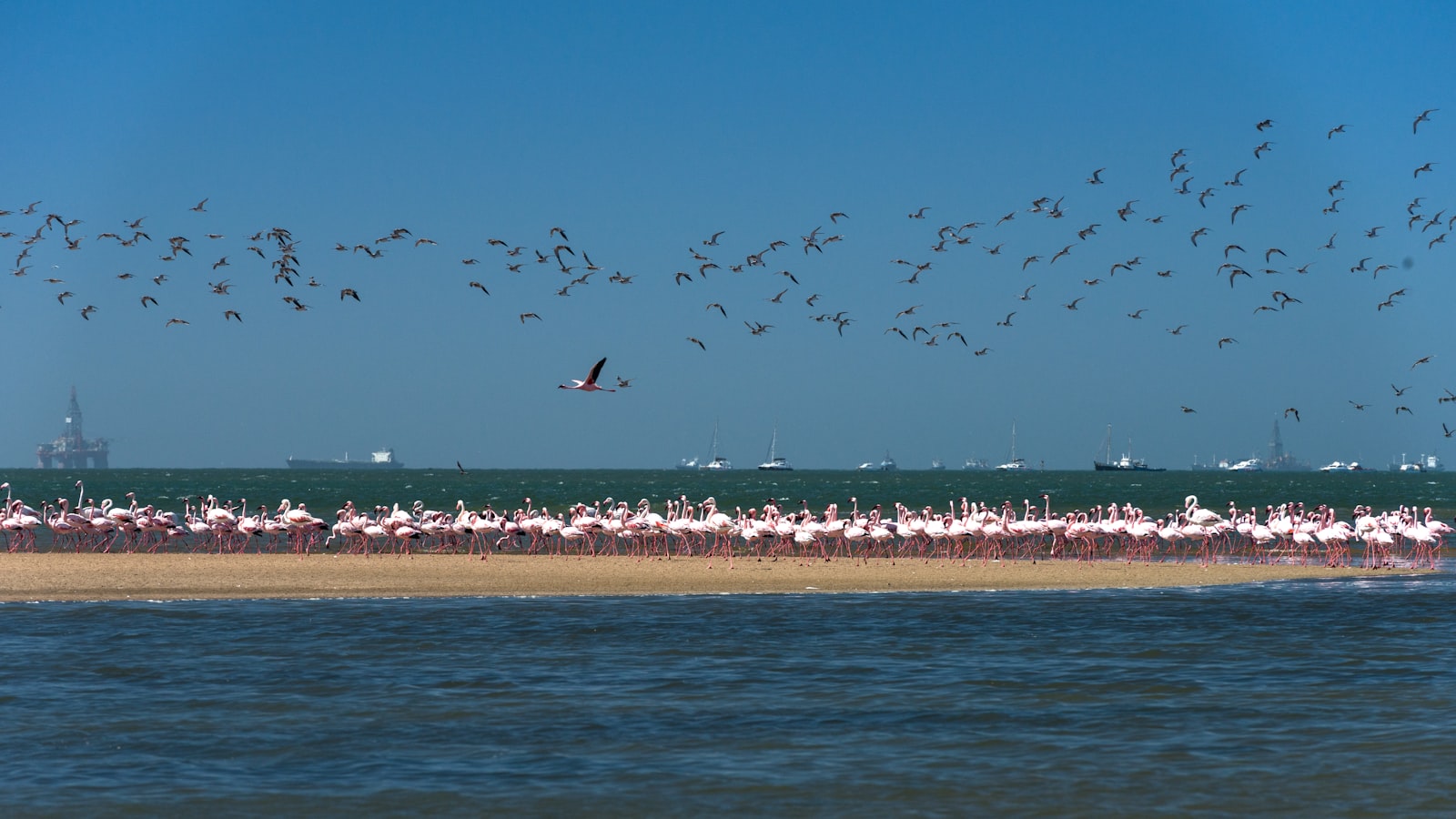
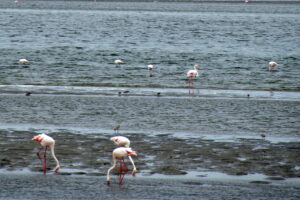
Walvis Bay, a short drive south of Swakopmund, is Namibia’s main deep-water port and commercial harbour. Its lagoon is one of southern Africa’s most important wetlands for flamingos and other waterbirds, and Dune 7, one of the tallest dunes in the area, lies just outside town. Pelican Point, on the sheltered spit enclosing the lagoon, is a popular spot for boat trips that may encounter seals and, occasionally, dolphins, though sightings are never guaranteed. A full destination guide is available.
Henties Bay, north of Swakopmund on the road toward Cape Cross and the Skeleton Coast, is a small, quiet town built primarily around shore-angling tourism, popular with anglers fishing for galjoen, kabeljou and other species from the beach. A full destination guide is available.
Wlotzkasbaken, a tiny historic fishing hamlet between Swakopmund and Henties Bay, consists of a scattering of colourful holiday shacks without mains electricity or piped water, an unusual and photogenic curiosity along the coast road.
Lüderitz, far to the south, is a windswept former diamond port known for its Art Nouveau colonial architecture, the abandoned mining ghost town of Kolmanskop nearby, and a complex, difficult colonial history. A full destination guide is available.
Oranjemund, in the far south at the mouth of the Orange River, remains a company mining town for Namdeb’s diamond operations and was only opened to general tourism relatively recently after decades of restricted access; visitor infrastructure remains limited.
Towns and places on the coast
Individual destination guides cover each coastal town in more depth.

Swakopmund. The coast’s main town, with German-colonial architecture and adventure activities.
Explore »
Walvis Bay. A working port town known for its lagoon and flamingos.
Explore »
Henties Bay. A quieter coastal town popular with anglers.
Explore »National parks, reserves and conservancies
Dorob National Park stretches along the central coast, linking the Swakopmund and Walvis Bay area to the Skeleton Coast further north and protecting the fragile gravel plains, lichen fields and lagoon habitats found along this stretch. The Skeleton Coast Park covers the remote northern coastline, known for shipwrecks, seal colonies, desert-adapted wildlife and a strong sense of isolation; much of it requires a fly-in permit or specialist guided access rather than casual self-drive exploration.
Natural attractions
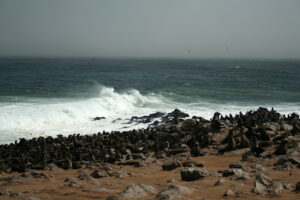
Cape Cross, north of Henties Bay, holds one of the largest Cape fur seal colonies in the world, with tens of thousands of animals present for at least part of the year, alongside a replica of the stone cross left by Portuguese navigator Diogo Cão in 1486. Walvis Bay’s lagoon and Pelican Point are important for birdlife and marine mammal watching respectively, and Dune 7 offers an accessible, dramatic dune close to town.
Historic and cultural sites
Swakopmund and Lüderitz both retain substantial German colonial architecture, and Lüderitz’s Shark Island and the abandoned settlement of Kolmanskop are among Namibia’s most significant and difficult historical sites, addressed in detail in the Lüderitz destination guide. The Cape Cross padrão replica marks the earliest recorded European presence on this coastline.
Suggested self-drive routes
A common coastal route runs from Swakopmund south to Walvis Bay for lagoon and dune activities, then back north along the coast road past Wlotzkasbaken to Henties Bay and on to Cape Cross for the seal colony, a full day trip from Swakopmund. Travellers continuing south to Lüderitz face a long inland detour via Sesriem or a more direct but remote coastal-adjacent route via Aus; this is a significant drive and should be planned as its own leg rather than a quick side trip.
Typical route connections
The B2 connects Swakopmund and Walvis Bay directly to Windhoek and central Namibia via Karibib and Okahandja, around four hours’ drive. The C34 coast road links Swakopmund north to Henties Bay, Cape Cross and, with appropriate planning, onward into the Skeleton Coast. Lüderitz is reached via the B4 from Keetmanshoop or Aus in Southern Namibia, while Sossusvlei and the Namib Desert region lies to the south-east of Walvis Bay via Solitaire.
Best time to visit
The coast can be visited year-round, though fog is a near-daily feature regardless of season, usually clearing by mid-to-late morning. Namibian and South African summer holidays (December-January) bring domestic tourists to Swakopmund and Walvis Bay in particular, so accommodation books up and prices rise; the shoulder months outside this period are quieter. Whale and dolphin sightings around Walvis Bay are most reliable in the cooler months from roughly June to November.
Suggested length of stay
Two to three nights based in Swakopmund allows time for the town itself, a half-day trip to Walvis Bay, and a half-day trip north to Cape Cross. Visiting Lüderitz as well typically requires its own two-night stop, given the driving distance involved, rather than being combined into the same short coastal leg.
Tours and activities on the coast
The coast carries more organised activity than anywhere else in Namibia — catamaran and kayak trips on the lagoon, dune and quad excursions, scenic flights and desert 4×4 outings. Guided options for the two main bases are listed on our Swakopmund tours and activities and Walvis Bay tours and activities pages, with the full national selection under tours and activities.
Accommodation context
Swakopmund has Namibia’s widest range of coastal accommodation, from guesthouses to larger hotels, and is the most practical base for exploring the central coast. Walvis Bay and Henties Bay have smaller selections aimed respectively at business travellers and anglers. Lüderitz has a more limited range of guesthouses and small hotels reflecting its smaller size and more remote position.
The coast holds more of Namibia’s accommodation than any other region. See Swakopmund accommodation and Walvis Bay accommodation for the two main bases, or the best hotels in Swakopmund guide for a comparison by style and budget.
Where to stay and what to book on the Namibian coast
Almost all coastal beds are in Swakopmund and Walvis Bay, with a smaller cluster at Henties Bay and nothing at all along the Skeleton Coast north of Terrace Bay. These three show the range across the two main towns.
Places to stay near the coast
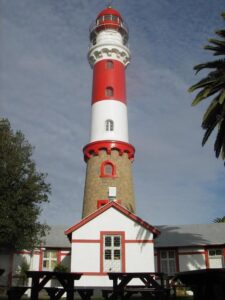
Sea Wind Self Catering Cottages Swakopmund
Sea Wind Self Catering Cottages Swakopmund is a 5-minute drive from Ocean View Shopping Centre, with Platz am Meer…
Price Guide: N$1,250
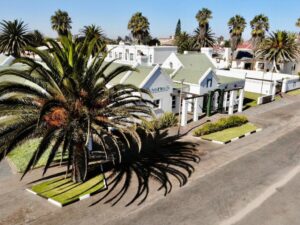
View Property DetailsLangholm Hotel
Langholm Hotel is a hotel in Walvis Bay. Check current availability and rates using the booking link on this page.
Price Guide: N$1,900
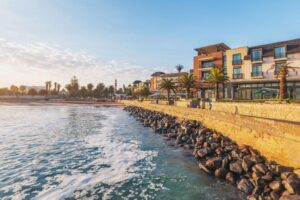
View Property DetailsStrand Hotel Swakopmund
Strand Hotel Swakopmund is a beachfront hotel on the Mole in Swakopmund, Namibia, with sea-facing rooms and several…
Price Guide: N$7,800–N$8,300
View Property Details
Check live availabilityBrowse all the coast accommodation
Tours and activities in the coast
Swakopmund Living Desert Tour
Explore the dune ecosystem outside Swakopmund on this guided half-day Living Desert tour.
View Tour DetailsSandwich Harbour Dune and Seal Tour
Combine dune driving, a huge seal colony and Walvis Bay's wetlands birdlife on this full-day Sandwich Harbour tour.
View Tour DetailsCape Cross Seal Colony Tour
See thousands of Cape fur seals on this Cape Cross seal colony tour along the Skeleton Coast from Swakopmund.
View Tour Details

See all the coast tours and activities
Some booking links are affiliate links. We may earn a commission at no extra cost to you. See our affiliate disclosure.
Road and vehicle considerations
The main coast road between Swakopmund, Walvis Bay and Henties Bay is tarred and easy driving. Roads north of Cape Cross into the Skeleton Coast proper and some southern routes toward Lüderitz include long gravel stretches; a standard sedan can generally manage the main routes in good conditions, but higher clearance is worthwhile for gravel sections and travellers should check current conditions before continuing beyond Cape Cross independently, since parts of the far northern coast require permits or guided access.
Fuel, supplies and practical services
Swakopmund and Walvis Bay have good supermarkets, fuel, banks and vehicle services. Henties Bay has basic fuel and supplies. North of Cape Cross and around Lüderitz, services thin out considerably, and travellers should fill up and stock up before continuing into more remote stretches of coastline.
Responsible travel
The Cape Cross seal colony has a strong, distinctive smell and produces a large amount of noise; visitors should stay on designated boardwalks and viewing areas both for their own safety and to avoid disturbing the animals. Shark Island in Lüderitz is a site of genocide and mourning, addressed in more depth in the Lüderitz guide, and should be treated with the same seriousness as any other memorial site rather than purely as a scenic camping spot.
Nearby regions
The Namibia Coast connects to Windhoek and Central Namibia to the east via the B2, to Erongo Inland along the same corridor through Karibib and Usakos, to Sossusvlei and the Namib Desert to the south-east, and to Southern Namibia in the far south via Lüderitz and Aus.
Existing destination guides
Full destination guides are available for Walvis Bay and Henties Bay. Full destination guides are now available for Swakopmund and Lüderitz; guides for Cape Cross and the Skeleton Coast are still to come.
Frequently asked questions
Is the Namibia coast always foggy?
Fog is a near-daily occurrence, particularly overnight and in the early morning, but it usually clears by mid-to-late morning, leaving clear afternoons in most cases.
Can I drive from Swakopmund to Lüderitz in a day?
It is a long drive of several hundred kilometres, mostly inland rather than along the coast itself, and is better treated as a full travel day with an overnight stop rather than a quick side trip.
Do I need warm clothing on the Namibia coast?
Yes. Even in summer, mornings and evenings are cool and foggy, and warmer layers than you might expect for a desert country are genuinely useful.
Last reviewed: July 2026.
Planning a coastal stop?
The coast pairs well with Sossusvlei and the north-west on a longer circuit. See Destinations and Itineraries for route ideas.
Self-Drive Namibia guideLast reviewed: 27 July 2026.
Further reading: the coast runs on its own weather — best time to visit Namibia explains the fog, wind and temperature patterns that make it so different from the interior.
Deciding where to base yourself on the coast? Swakopmund vs Walvis Bay compares the two towns on atmosphere, activities, birdlife and route position.