
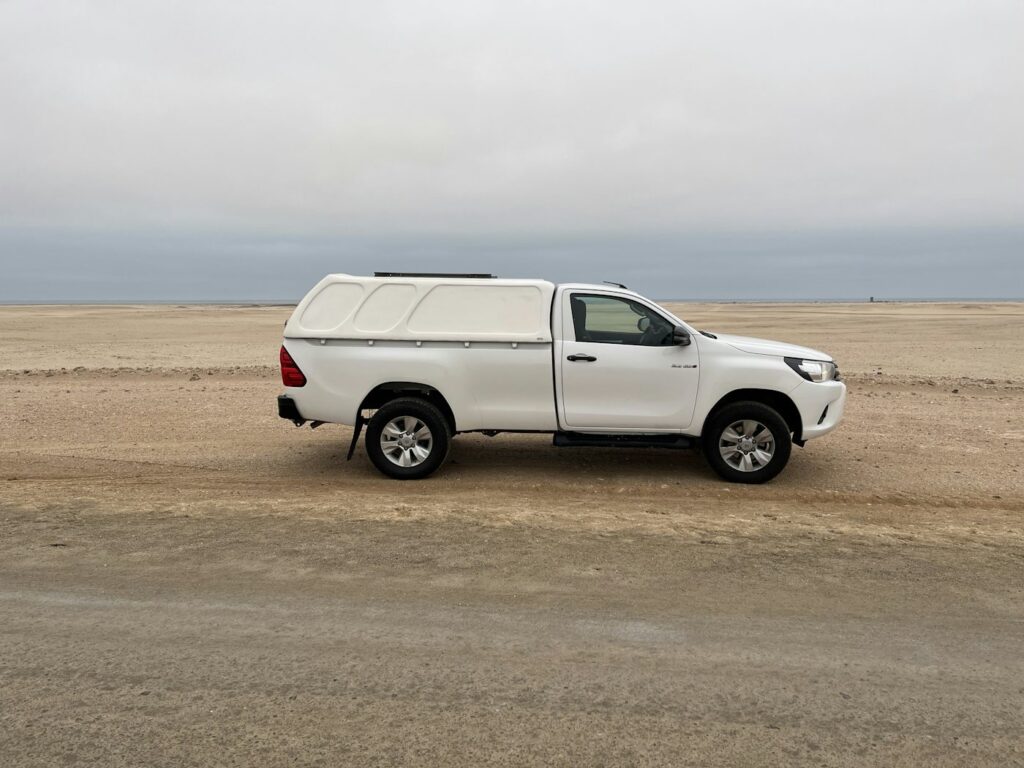
Namibia is one of the few countries where hiring your own vehicle is not the adventurous option — it is the normal one. There is very little public transport between the places most visitors want to see, domestic flights are limited and expensive, and the distances are long enough that a guided transfer for every leg quickly costs more than a rental. For most itineraries, the vehicle is the trip.
This page covers the part that is genuinely easy to get wrong: what you are actually renting, what the contract lets you do with it, and where it makes sense to collect it. It deliberately does not quote prices — Namibian rental rates move by season, by vehicle class and by how far ahead you book, and a number written into a guide page is a number that is wrong within weeks.
A 4×4 badge is a description of the vehicle, not a permission
This is the single most common misunderstanding in Namibian car hire, and it catches experienced drivers as often as first-timers. Booking a 4×4 does not buy you the right to drive off-road. It buys you a vehicle that is capable of more than a hatchback. What you are permitted to do with it is set by the rental agreement, and that agreement is usually far more restrictive than the marketing photograph suggests.
The pattern is remarkably consistent across the market. International brands operating in Namibia typically limit you to roads that are suitable for the vehicle, and exclude damage caused by driving through rivers, streams, dams or flooded roads. Breach the use clause and the damage waiver you paid for may simply not apply — some agreements set the resulting liability at several times the normal excess.
Local Namibian 4×4 specialists are not automatically more permissive. It is common for a specialist agreement to prohibit off-road driving through bush and riverbeds as well as dune driving outright, to void cover if you were speeding on gravel, and — this is the important one — to exclude a single-vehicle rollover from cover entirely. A rollover on loose gravel with no other vehicle involved is one of the most common serious incidents in Namibia, and it is precisely the case many policies carve out.
None of this means a 4×4 is a bad idea. It means the reason to take one is clearance, tyres, and comfort on corrugated gravel — not a licence to leave the road network. If your plan genuinely involves technical off-road driving, deep sand or notorious routes such as Van Zyl’s Pass, that is a different product: a specialist operator with equipment, permitted routes and usually convoy or guide conditions written into the contract. Do not assume any standard rental covers it, and do not find out at the claim stage.
Read the use clause before you read the price
Four clauses do most of the damage. Find them in whatever agreement you are offered, before you compare anything on cost:
- Where you may drive. Almost always proclaimed or gazetted roads — tar and maintained gravel. Riverbeds, dunes, beaches and open veld are usually excluded, with occasional narrow exceptions.
- Water. River and flooded-road crossings are a standard exclusion. In the rainy season this is not theoretical; a dry riverbed can run within an hour of rain falling somewhere you cannot see.
- Rollover. Check whether a single-vehicle rollover is covered, and at what excess. This is the clause people discover afterwards.
- Tyres and glass. Usually not part of the standard waiver, and usually offered as a separate add-on. On Namibian gravel this is one of the few add-ons that reliably pays for itself.
Our guide to driving in Namibia goes into road surfaces and conditions in more detail, and the mistakes to avoid covers what actually goes wrong on the road.
Which vehicle your itinerary actually needs
Vehicle choice follows the route, not the other way round. Three broad cases cover most trips:
- A standard 2WD is genuinely fine for the main circuit on tar and well-maintained gravel — Windhoek, Sossusvlei’s approach roads, Swakopmund, the Etosha tourist roads. Plenty of visitors do exactly this without difficulty.
- A high-clearance SUV or soft-roader is the usual sweet spot: better ground clearance, better tyres, a more forgiving ride on corrugations, and far less anxiety on the rougher district roads.
- A properly equipped 4×4 — often with rooftop tents, dual battery, long-range tank and two spares — is for camping-based trips, the remote north-west, and routes where you may go a long way between fuel stops.
We have a dedicated comparison at 4×4 vs 2WD in Namibia if you want to work through it against your own route.
Where to collect the vehicle
Namibia has more rental collection points than most people expect, and choosing the right one can remove a whole travel day from an itinerary.
- Windhoek Hosea Kutako International Airport (WDH) — the main international gateway and where most self-drive trips begin. It is roughly 45 km east of the city, so collecting here saves paying for a transfer you would otherwise need.
- Windhoek city — sensible if you are spending a night in the capital first rather than starting a long drive straight off an overnight flight.
- Windhoek Eros Airport (ERS) — the in-town airport, used mainly for domestic and charter flights.
- Walvis Bay Airport (WVB) — the coast’s airport. Note the name honestly: it serves Swakopmund, but it is at Walvis Bay, about 40 km down the coast road, so a Swakopmund stay still involves a drive.
- Swakopmund — a town pickup rather than an airport desk. Opening hours are shorter than airport counters, which matters if your incoming leg is late.
- Ondangwa (OND) — the far-north gateway, useful for Etosha’s northern side and onward travel into the Kunene.
- Lüderitz (LUD) — a small southern airport with a correspondingly narrow choice of vehicles.
- Katima Mulilo — the far east, in the Zambezi Region, mostly relevant to cross-border routes.
One-way rentals within Namibia, and in some cases into South Africa or Botswana, do exist, but they carry a one-way fee and are not offered on every vehicle class. If a one-way leg is central to your plan, confirm it before you build the itinerary around it.
Crossing a border
Most rental companies do not allow their vehicles to leave Namibia by default. Where cross-border travel is permitted — South Africa and Botswana most commonly, sometimes Zambia and Zimbabwe — it needs a written cross-border permit arranged in advance, often with a minimum notice period before collection, and there is usually a fee. Turning up at Ariamsvlei or Ngoma without that paperwork means turning around. We cover the practicalities in crossing the border into Namibia by car.
Ten minutes at the counter that are worth taking
Before you drive away, do the walk-around properly. It is the cheapest insurance available.
- Check the spare — that it exists, that it is inflated, and on a longer gravel route whether a second spare is available. Confirm the jack and wheel brace are actually in the vehicle and that you can reach them.
- Look at tread depth and sidewalls on all five tyres. Gravel destroys sidewalls, not tread.
- Photograph every existing scratch, chip and dent, including the windscreen and the roof, and get the damage sheet signed.
- Ask what the tyre pressure should be for gravel, and whether they expect you to change it.
- Save the 24-hour assistance number into your phone and write it somewhere that does not need a battery.
- Confirm the fuel policy and the fuel type. Diesel and petrol are both common in Namibian rental fleets.
Fuel, distance and the plan around the vehicle
A vehicle only solves the transport problem if the route is realistic. Namibian distances are long and gravel travel times are not the same as tar travel times — a rule of thumb many visitors learn the hard way. Our driving distances and travel times page gives real figures for the common legs, and fuel planning covers the stretches where filling up when you can matters more than filling up when you need to.
Common questions
Do I need a 4×4 to visit Sossusvlei and Etosha?
No. Both are reachable in a standard 2WD on maintained roads. The last five kilometres to Sossusvlei itself is deep sand and is closed to 2WD vehicles, but a shuttle runs that section. A high-clearance vehicle makes the approach roads more comfortable rather than more possible.
Is an international driving permit required?
A licence in English with a photograph is generally accepted. If your licence is not in English, carry an international driving permit alongside it. Rental companies set their own minimum age and minimum licence-held period, so check both if you are under 25.
Can I drive on the beach or in the dunes?
Almost certainly not under a standard rental agreement, and in many places not legally either. Sensitive coastal and desert areas are permit-controlled, and dune driving is explicitly excluded by most contracts — including specialist ones. Where beach driving is allowed at all it tends to be a narrow, named exception.
What happens if I get a puncture in the middle of nowhere?
You change it yourself. That is why the spare, the jack and the brace matter more than almost anything else on the vehicle, and why a second spare is worth asking about on remote routes. Mobile coverage is patchy to absent across much of the country, so do not assume you can call for help from where you break down.
Why doesn’t this page quote prices?
Because they would be wrong. Namibian rental pricing swings with season, vehicle class, lead time and one-way fees. A figure typed into a guide page ages badly and misleads people who read it six months later. Check live rates when you are ready to book, and compare the same insurance level across quotes rather than the headline daily rate.
Where to go next
- Self-drive Namibia — the full preparation guide.
- 4×4 vs 2WD in Namibia — what you actually need.
- Driving in Namibia — roads, conditions and what to expect.
- Self-drive mistakes to avoid.
- Driving distances and travel times.
- Namibia itineraries — routes built around a vehicle.