

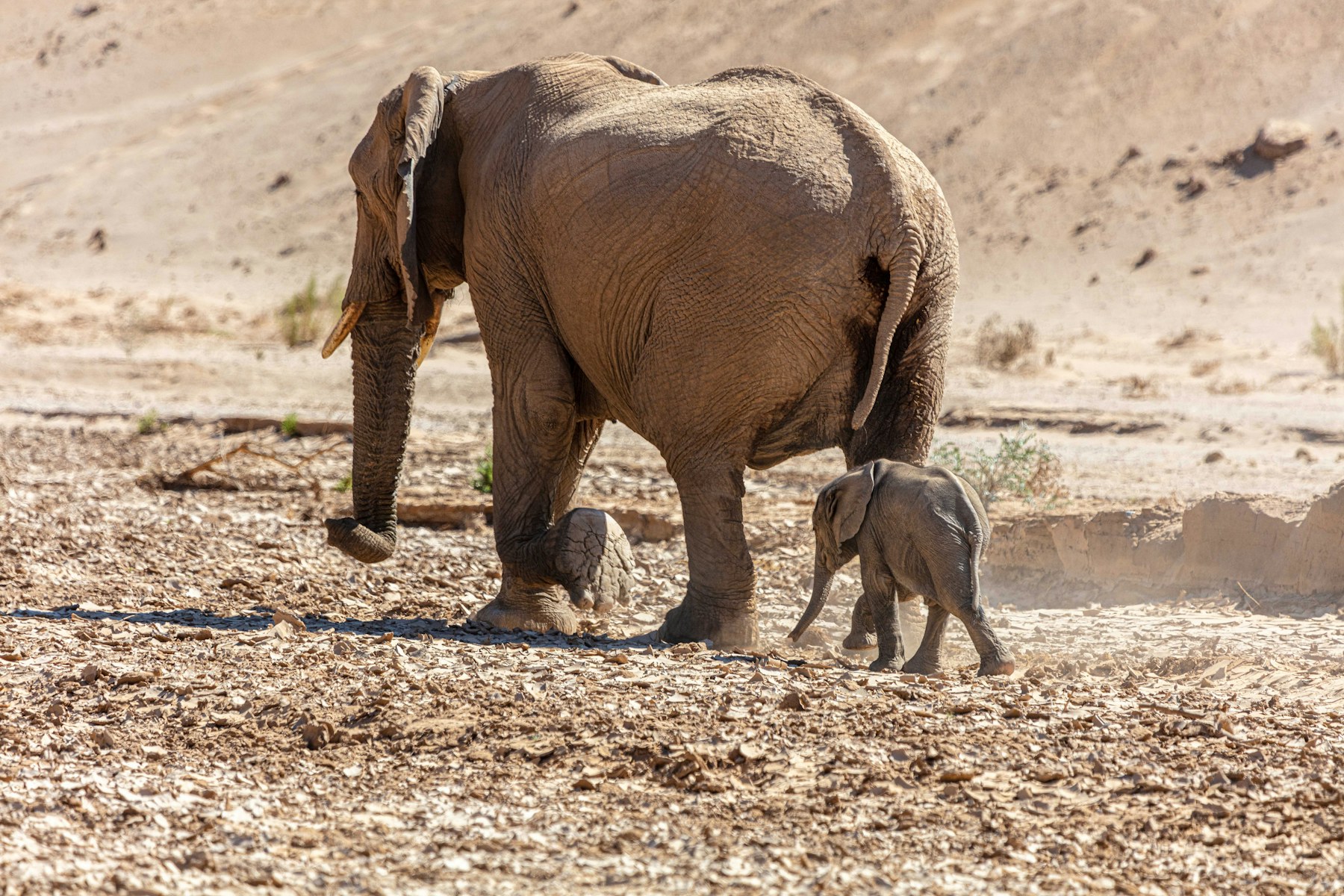
Desert-adapted elephants range through parts of north-west Namibia, using dry river systems, springs and seasonal food across a large landscape. They are not a separate species and they are not confined to a predictable tourist circuit. Finding them is never guaranteed, even with excellent local knowledge.
The responsible way to look for desert-adapted elephants is with an experienced local guide or conservancy-linked operator. Guides understand recent movement, sensitive areas, road conditions and the distance needed to avoid pushing animals or disrupting people who live and farm in the same landscape.
In this guide
desert-adapted elephants: a practical overview
Treat desert-adapted elephants as free-ranging wildlife, not an attraction that must be delivered. Sightings depend on rain, water, vegetation and daily movement. A good excursion explains tracks, geology, plants and community conservation whether or not elephants appear.
Use the right regional base
Areas around the Huab, Ugab and other north-west river systems are often associated with sightings, but ranges change. Ask a Damaraland accommodation which ethical operators are active locally. Desert-adapted elephants may be far from the place where someone saw them last week.
Do not follow social-media coordinates into remote riverbeds. Tracks can require four-wheel-drive skill, may be restricted by rental contracts and may cross sensitive community land.
Go with current local knowledge
A qualified guide can read spoor, recognise stress and communicate with other operators. When looking for desert-adapted elephants, this reduces aimless driving and the risk of approaching a family group from the wrong direction.
Ask how the operator contributes to local conservation and limits vehicle numbers. Responsible guiding is more than finding an animal; it manages the whole encounter.
Let elephants choose the distance
Stop well before the animals need to change course. Desert-adapted elephants may approach or cross near a vehicle, but that does not justify moving closer. Keep an escape route and obey the guide immediately.
Never position between adults and calves, block a path to water or surround a group with multiple vehicles. If ears spread, heads rise or movement becomes directed toward the vehicle, increase distance.
Choose a base with ethical local guiding
Compare Damaraland stays by conservancy links, guide experience and responsible wildlife policies.
Remember that this is a shared landscape
Elephants move through conservancies, farms and settlement areas where water and crops matter to livelihoods. Responsible desert-adapted elephants tourism respects local instructions, gates, livestock and privacy.
Do not enter homesteads, photograph residents or use private water points without permission. Spend with community-linked guides and businesses where possible.
Value the landscape when no elephant appears
A dry river drive may reveal oryx, giraffe, birds, geology and plant adaptations. The search for desert-adapted elephants should not become a high-speed chase or pressure on the guide to manufacture a sighting.
A no-sighting day is an honest wildlife experience. Record what was learned and leave the animals undisturbed for the next visitor and, more importantly, for the people sharing the region.
Final checks before you travel
- Book an experienced local or conservancy-linked guide.
- Never chase coordinates into remote riverbeds.
- Keep clear escape routes and follow instructions immediately.
- Do not block water, calves or community access.
- Accept that sightings are never guaranteed.
The official Arid Eden route provides regional context for the north-west. Our Damaraland guide helps select a base. Ask the chosen operator how road conditions, recent rain and animal movement have shaped the week; the answer is a useful test of current local knowledge. Desert-adapted elephants are remarkable precisely because they live on their own terms in a difficult, shared landscape.