
Destinations > Namibia Coast > Swakopmund
Swakopmund
A German colonial-era seaside town where Atlantic fog, dunes and adventure tourism meet.
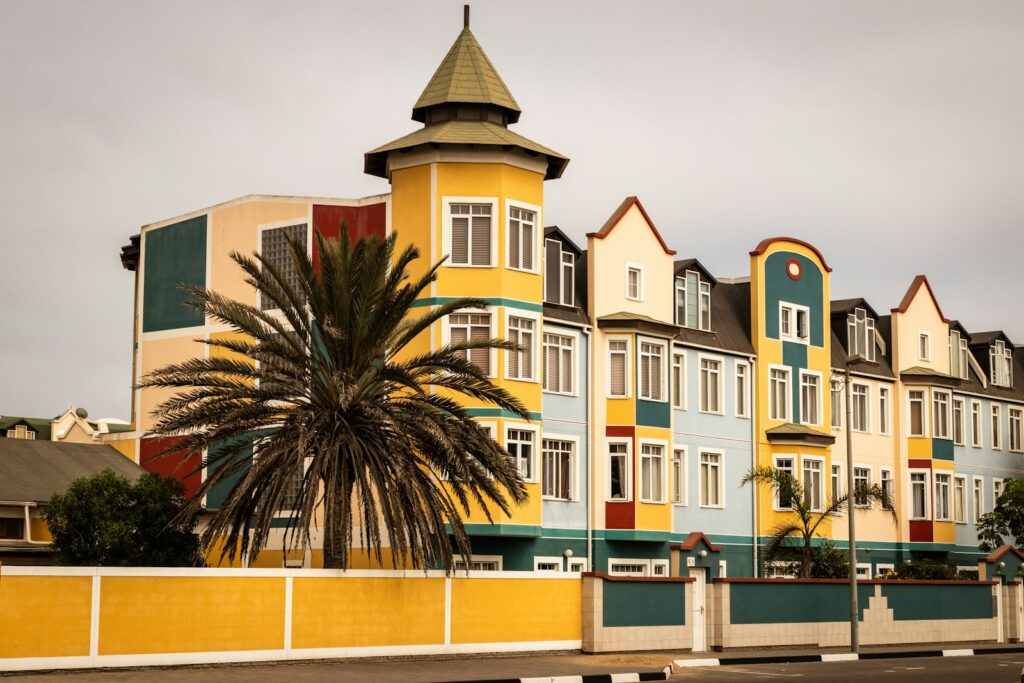
Swakopmund sits where the cool Atlantic meets the red dunes of the Namib, and the town still looks the part: gabled facades, a working jetty, palm-lined avenues and a startling amount of German-language signage for a town on the edge of one of the driest deserts on Earth.
For most visitors it is the natural counterpoint to Windhoek and to Etosha: a coastal base for adrenaline activities in the dunes, gentler pursuits along the promenade, and a genuinely walkable historic centre that rewards a day or two of unhurried exploring. It is also, unavoidably, a town whose orderly streets and preserved colonial buildings sit on top of a much harder history, and a serious visit engages with that history rather than skating past it.
Swakopmund at a glance
Geographic setting
Swakopmund lies on Namibia’s Atlantic coast at the mouth of the (usually dry) Swakop River, roughly midway along the country’s coastline and about 30 minutes’ drive north of the larger port of Walvis Bay. The town is hemmed in by the Namib Desert on its landward side and the cold Benguela Current offshore, a combination that defines almost everything about the place: the persistent sea fog and mist that roll in overnight and burn off by mid-morning, the dune fields that begin almost at the edge of the built-up area, and the sharp temperature contrast between the coast and the desert interior only a short drive away.
History
Long before German colonists arrived, the Namib coast around the Swakop River mouth was used by Nama and Damara communities and by other groups moving between the interior and the coast, though the area’s aridity and lack of a natural harbour meant it never supported large permanent settlements in the way some interior regions did. Access to fresh water at the river mouth made the site useful as a stopping point.
Germany established Swakopmund in 1892 as the main harbour for German South West Africa, after Walvis Bay (the only natural deep-water harbour on this stretch of coast) had already been claimed by Britain and incorporated into the Cape Colony. Because Swakopmund’s open roadstead offered no natural shelter, the Germans built an iron pier and later a stone jetty to land goods and passengers, and the town grew quickly as the colony’s administrative and military supply point, connected to Windhoek by one of the territory’s first railway lines.
The colonial period in this region, as elsewhere in German South West Africa, included the dispossession of Nama and Herero land and the 1904 to 1908 war and genocide carried out by German colonial forces against the Herero and Nama peoples; Swakopmund itself served as a landing point for German troops and supplies during that war, and this history should not be set aside in favour of the town’s architecture alone.
South African forces occupied the territory during the First World War, and South West Africa (including Swakopmund) remained under South African administration, later under apartheid law, until Namibian independence in March 1990. Walvis Bay, just down the coast, remained under direct South African sovereignty even after Namibian independence and was only transferred to Namibia in 1994. Since independence Swakopmund has developed into Namibia’s leading coastal tourism town, its colonial-era buildings largely preserved and adapted for hotels, restaurants, museums and shops rather than demolished, which is why the historic centre still reads so strongly as a German coastal resort transplanted onto the Namib.
Architecture and townscape
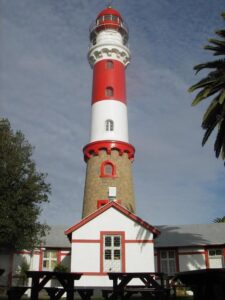
Swakopmund’s historic core is dense with early-20th-century German colonial architecture: turreted villas, half-timbered gables, wrought-iron balconies and public buildings built in a solid, formal style intended to project imperial permanence. Notable landmarks include the old Railway Station (now housing a hotel), the former District Court, the lighthouse next to the jetty, and the Hohenzollern Building with its ornate facade. Walking the grid of streets between the seafront and the town centre is the easiest way to take in this architecture, and most of it is within a compact, walkable area.
Seafront and jetty
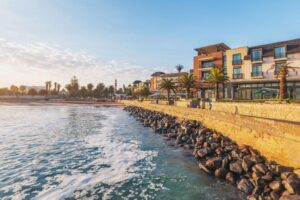
The Swakopmund Jetty, rebuilt in steel after the original wooden and iron structures suffered storm and corrosion damage, is the town’s best-known landmark and a popular spot for an evening walk, a coffee, or fishing. The promenade along the seafront links the jetty to the lighthouse and the small formal gardens near the museum, and is the most pleasant way to get a feel for the town’s layout on foot.
Museums and heritage
The Swakopmund Museum, near the lighthouse, covers the town’s natural and colonial history, including exhibits on the Namib Desert, local geology and the German colonial period. The National Marine Aquarium on the seafront focuses on the marine life of the cold Benguela Current. Note that the aquarium has been closed for an extended refurbishment, so check whether it has reopened before planning a visit.
Visitors with a specific interest in the colonial and genocide history of the region are better served by combining a Swakopmund visit with reading and with visits to sites in Windhoek and Lüderitz that engage more directly with that history, since Swakopmund’s own museum treatment of the German period has historically been criticised for being incomplete.
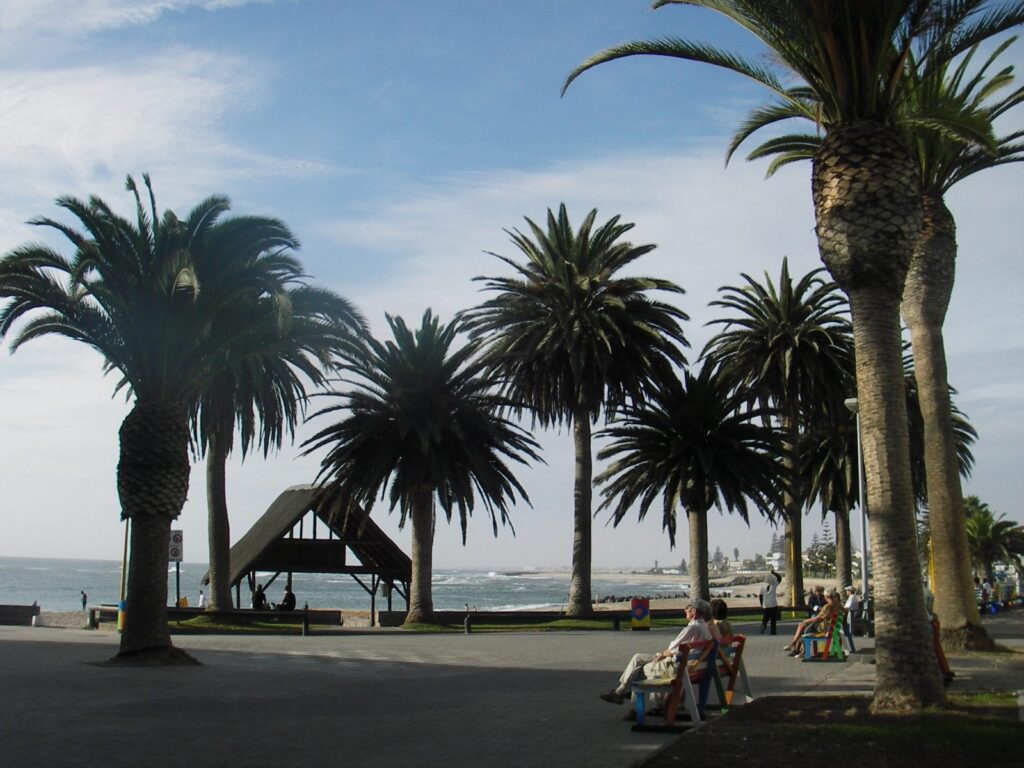
The seafront promenade and jetty are the town’s social spine — a place to walk, fish, or sit out the fog with a coffee.
Desert activities
Swakopmund’s position on the edge of the Namib Desert makes it Namibia’s main base for dune-based adventure tourism. Popular activities include quad biking and sandboarding on the dunes just south and east of town, scenic flights over the dune sea and the Skeleton Coast, and half- or full-day 4×4 excursions into the Moon Landscape and Welwitschia Plains to see the ancient welwitschia plants, some of which are well over a thousand years old. Operators vary in how responsibly they manage dune traffic, and visitors who care about the desert environment should ask how routes are chosen and rotated before booking.

Coastal activities
Boat trips from nearby Walvis Bay’s lagoon offer close encounters with Cape fur seals, dolphins and occasionally whales, and are usually combined with a stop for oysters. Closer to Swakopmund itself, activities include birdwatching along the Swakop River mouth, fishing off the jetty, and, for the more adventurous, skydiving with the dune sea and coastline as a backdrop. The cold Benguela Current keeps swimming water temperatures low year-round, so the coast here is better suited to walking, birdwatching and boat trips than to swimming.
Tours and Activities
Beyond exploring on your own, a range of guided tours and activities operate out of Swakopmund, from dune quad biking and sandboarding to Living Desert wildlife tours, scenic flights and day trips to Spitzkoppe. Booking a guide for these activities generally gets you specialist local knowledge, the right vehicle or equipment, and safety oversight that would be harder to arrange independently.
We’ve researched and compared the main bookable options, including typical duration, departure points and traveller reviews, on a dedicated page. Explore tours and activities in Swakopmund for the current options.
Restaurants and shopping
Swakopmund has the widest choice of restaurants on the Namibian coast, with a strong seafood tradition (linefish, oysters and rock lobster in season) alongside German-influenced cafés, bakeries and beer gardens that reflect the town’s history. The town centre also has the best shopping outside Windhoek, including craft markets, outdoor-gear shops geared toward self-drive travellers, and galleries selling Namibian art and semi-precious stones.
Main areas
The historic centre, between the railway station and the seafront, holds most hotels, restaurants and shops and is entirely walkable. The area directly along the promenade is quieter and favoured for sea-view accommodation. You can browse Swakopmund accommodation by price and type on the accommodation hub. Further inland and to the south, newer residential suburbs have less tourist infrastructure but are sometimes used for self-catering stays. Mole, the small sheltered bay near the jetty, is a popular spot for an early-morning walk.
Where to stay
Accommodation in Swakopmund ranges from historic hotels in converted colonial buildings, to modern sea-facing hotels along the promenade, to guesthouses and self-catering apartments in the town centre and quieter backpacker lodges further out. Staying within or close to the historic centre makes the most sense for visitors without a hire car, since restaurants, the museum, the jetty and most tour operators are within easy walking distance.
Two curated shortlists narrow the choice further: our guide to the best hotels in Swakopmund covers seafront and central options by style and budget, while the best self-catering in Swakopmund is more useful if you are travelling as a family, staying several nights, or want to cook after a run of lodge dinners.
Where to stay and what to book in Swakopmund
Swakopmund has the deepest accommodation choice on the Namibian coast, from self-catering flats a street back from the beach to the seafront hotels. These three show the range; the map and availability search cover the whole town.
Places to stay near Swakopmund
Sea Wind Self Catering Cottages Swakopmund
Sea Wind Self Catering Cottages Swakopmund is a 5-minute drive from Ocean View Shopping Centre, with Platz am Meer…
Price Guide: N$1,250
View Property DetailsHotel Deutsches Haus Swakopmund
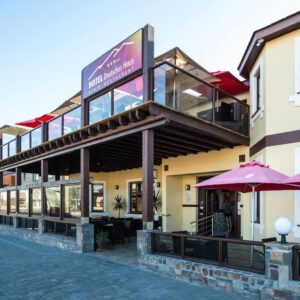
Hotel Deutsches Haus Swakopmund is a well-established hotel on Luderitz Street in central Swakopmund, built around…
Price Guide: N$2,600–N$2,800
View Property DetailsStrand Hotel Swakopmund
Strand Hotel Swakopmund is a beachfront hotel on the Mole in Swakopmund, Namibia, with sea-facing rooms and several…
Price Guide: N$7,800–N$8,300
View Property Details
Check live availabilityBrowse all Swakopmund accommodation
Tours and activities in Swakopmund
Swakopmund Living Desert Tour
Explore the dune ecosystem outside Swakopmund on this guided half-day Living Desert tour.
View Tour DetailsSwakopmund Quad Biking and Sandboarding Combo
Combine quad biking and sandboarding on this 3-hour Swakopmund sandboarding tour through the Namib dunes.
View Tour DetailsCape Cross Seal Colony Tour
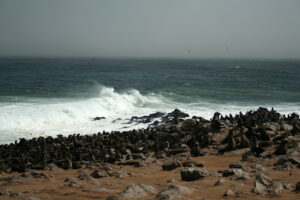
See thousands of Cape fur seals on this Cape Cross seal colony tour along the Skeleton Coast from Swakopmund.
View Tour Details


See all Swakopmund tours and activities
Some booking links are affiliate links. We may earn a commission at no extra cost to you. See our affiliate disclosure.
Coastal fog and climate
The Benguela Current keeps Swakopmund notably cooler than inland Namibia year-round, with frequent morning fog and low cloud that usually clears by late morning, giving way to clear, mild afternoons. Many visitors are surprised at how cool the coast feels compared with Windhoek or Etosha, and a light jacket is useful even in summer months. This fog is also ecologically important, sustaining desert life such as the welwitschia and various dune-dwelling insects and reptiles that draw moisture from it.
Getting there and around
Swakopmund is reached via a tarred road from Windhoek (via Okahandja and the Khomas Hochland escarpment, roughly four hours’ drive) or from Walvis Bay, thirty minutes to the south on a good tarred road. Walvis Bay Airport, a short drive away, handles domestic flights connecting to Windhoek. Within Swakopmund itself, the historic centre and seafront are easily covered on foot; a hire car or organised tour is needed to reach the dune activities, Walvis Bay, and sites further along the coast such as Cape Cross.
Suggested length of stay
Two nights allow time for a walking tour of the historic centre, a dune activity, and a Walvis Bay boat trip. Three to four nights give room to add a Welwitschia Plains or Moon Landscape excursion, a visit to Cape Cross, and unhurried time for the town’s restaurants and shops, without needing to rush between activities.
For a sense of how those nights sit inside a wider route, the 10-day itinerary pairs the coast with Sossusvlei and Etosha, while the 14-day itinerary allows a slower coastal leg with time for Walvis Bay as well.
Day trips
Walvis Bay and its lagoon (flamingos, pelicans and boat trips) are thirty minutes away. Cape Cross Seal Reserve, home to one of the largest Cape fur seal colonies in Africa, is a half-day return trip north along the coast. The Moon Landscape and Welwitschia Plains lie inland along the Swakop River valley and can be combined into a half-day 4×4 excursion. Dune 7, near Walvis Bay, is a popular short trip for sandboarding or simply climbing one of the tallest dunes in the area.
The most demanding day trip is Sandwich Harbour, the lagoon system south of Walvis Bay where the dunes meet the Atlantic. It is not a self-drive destination: access crosses tidal salt flats and soft sand, requires a permit and local knowledge, and is realistically only done on a guided 4×4 tour departing from Walvis Bay. Trips are tide-dependent, so timing is set by the sea rather than your schedule.
Nearby destinations
Swakopmund is part of the Namibia Coast region and anchors routes north along the coast and inland toward the desert and the capital.

Walvis Bay
The lagoon town 30 minutes south, known for flamingos and its natural harbour.
Sossusvlei
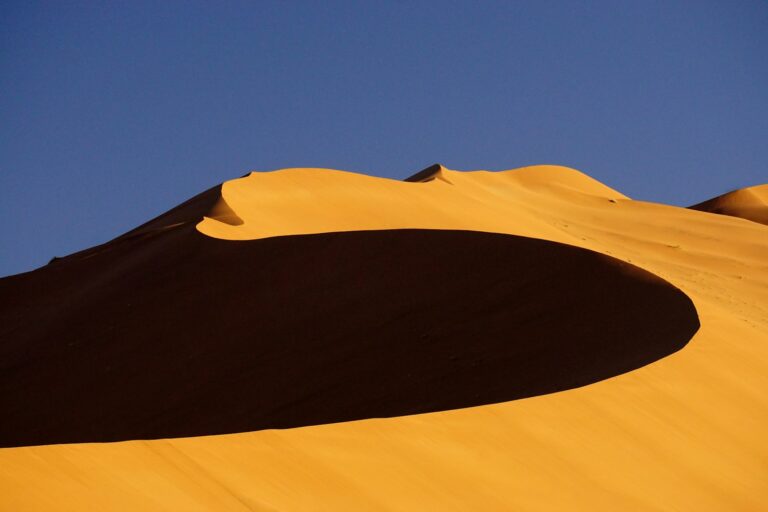
Namibia’s iconic dune landscape, commonly combined with Swakopmund on a central loop.

Self-Drive Namibia
How Swakopmund fits into a wider self-drive circuit around the country.
Frequently asked questions
Is Swakopmund worth visiting if I am not interested in adventure sports?
Yes. The historic centre, museum, jetty, seafront promenade and restaurant scene are worth two or three days on their own, and boat trips or a Welwitschia Plains drive offer gentler alternatives to quad biking or sandboarding.
Can I swim at Swakopmund?
The Benguela Current keeps the sea cold year-round, so swimming is possible but chilly; most visitors focus on walking, birdwatching and boat trips rather than swimming.
How do I get from Swakopmund to Sossusvlei?
Sossusvlei and Sesriem are reached by road via Solitaire, generally taking four to five hours depending on route and road conditions; see the Sossusvlei guide for details.
Last reviewed: July 2026.
Planning the rest of your trip?
See how Swakopmund fits into a full Namibia route, and what to prepare before you drive there.
Choosing between the two coastal towns? Swakopmund vs Walvis Bay sets out what each is genuinely better at.