
Destinations > Sossusvlei and the Namib Desert > Sossusvlei

Sossusvlei
Namibia’s most photographed landscape: towering red dunes, a bone-white clay pan and the ghostly trees of Deadvlei.
Sossusvlei is the single most photographed landscape in Namibia: immense, rust-red dunes rising above a bone-white clay pan, with dead, blackened camel-thorn trees standing in stark contrast against the sand. It is also one of the most misunderstood destinations in the country, because “Sossusvlei” is often used loosely to describe an entire area that actually contains several distinct places: the small settlement of Sesriem, the Sesriem Canyon, the dune road through Namib-Naukluft National Park, and the pans of Sossusvlei and Deadvlei themselves. Understanding the difference between these makes for a much better-planned visit.
Telling the places apart
Geography and formation
The dunes here are part of one of the oldest and largest dune systems on Earth, built up over millions of years from sand carried by the Orange River to the Atlantic coast, then pushed inland and shaped by wind into a “star dune” pattern in places, and into long linear dunes elsewhere. The Tsauchab River occasionally reaches this far into the desert after exceptional rains, forming the clay pans of Sossusvlei and Deadvlei where the water pools and evaporates; the pans themselves are usually dry, cracked white clay for most of the year, since the river reaches them fully only rarely.
The deep red-orange colour of the older dunes comes from oxidisation of iron in the sand over many thousands of years, which is why the dunes closest to the coast, where sand is geologically younger, tend to appear paler than those further inland around Sossusvlei itself. This age gradient is one of the reasons the dunes here are studied by geologists as well as photographed by visitors.
Dunes and viewpoints
Several named dunes along the access road have become well-known viewpoints and are commonly climbed for sunrise or sunset views over the surrounding dune sea. “Dune 45”, roughly 45 kilometres along the road from Sesriem, is the most visited, both for its relatively easy access and its classic dune shape. “Big Daddy”, near Deadvlei, is one of the tallest dunes in the area and a much longer, more strenuous climb, usually undertaken by fitter visitors as an early-morning activity before the heat builds. Climbing any dune is optional; the view from ground level, especially of Deadvlei’s dead trees against the dunes, is spectacular in its own right and requires no climbing at all.

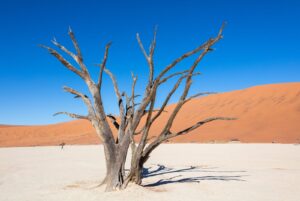
Deadvlei’s blackened trees against white clay and red dunes make it, for many photographers, the single most striking site in the area.
Access route and the final stretch
From Sesriem gate, a tarred road runs about 60 kilometres to a car park at “2×4 parking”, from where the road continues a further few kilometres to Sossusvlei and Deadvlei across soft sand that requires a 4×4 vehicle. Visitors without their own 4×4 can park at the 2×4 area and either walk the remaining stretch (long, hot, and not recommended in the middle of the day) or use one of the shuttle vehicles that operate this final section. This last few kilometres of deep sand is the single biggest planning point for a Sossusvlei visit: a standard sedan should not attempt it.

Sesriem is the gateway for the whole area — the last fuel, the park gate, and the start of the drive out to the dunes.
Vehicle considerations
The tarred road from Sesriem to the 2×4 car park is suitable for any vehicle. The final sand stretch to Sossusvlei and Deadvlei needs low-range 4×4 capability and, ideally, some experience driving in soft sand, since vehicles regularly get stuck here. Visitors without a suitable vehicle or confidence in soft-sand driving should use the shuttle service rather than risk it themselves.
Heat, hydration and timing
Daytime temperatures on the dunes can be extreme, particularly in the middle of the day in summer months, and there is no shade of any significance along most of the walk to Deadvlei or on the dunes themselves. Carrying more water than seems necessary, wearing a hat and sun protection, and avoiding strenuous dune climbs in the hottest part of the day are all sensible precautions. Rather than relying on specific published gate-opening times, which can change, visitors should confirm current gate hours locally and plan to arrive as early as permitted, both to catch the best light and to avoid the worst heat.
Responsible visitation
Deadvlei’s clay surface and the dunes around it are fragile and slow to recover from off-track damage, so visitors should stick to established paths and avoid walking on the pan’s surface unnecessarily beyond viewing areas. Climbing dunes leaves visible footprints that can last a long time in this low-wind, arid environment, so some photographers prefer to view rather than climb the more pristine dune faces.

Photography considerations
Sossusvlei and Deadvlei are among the most photographed landscapes in southern Africa, and the quality of light rather than the time of year usually makes the difference between an ordinary photograph and a memorable one. The first hour after the gates open produces long shadows and strong colour contrast on the dune faces, which is why photographers commonly plan to be among the first vehicles through the gate rather than arriving mid-morning. Midday light tends to flatten the dunes’ colour and texture, so visitors travelling primarily for photography should treat the early morning and, to a lesser extent, the final hour before gate closing as the priority windows rather than assuming any time of day will do.
None of this can be guaranteed in advance: dust haze, cloud and haziness from distant fires do occur and cannot be predicted from home, so it is sensible to build a little flexibility into a itinerary rather than planning around a single sunrise. A wide-angle lens suits the dune sea and Deadvlei’s dead trees, while a longer lens can help isolate dune ridgelines and patterns from a distance without needing to walk onto fragile surfaces.
How the dunes formed
The sand at Sossusvlei has travelled a very long way. Material eroded out of the interior was carried south-west to the Atlantic by the Orange River, moved north along the coast by currents, deposited on the shore, and then driven inland again by the prevailing wind. The iron in the grains oxidises over time, which is why the older, further-inland dunes read as deep rust-red while the younger coastal sand is paler.
The pans themselves are the work of the Tsauchab, an ephemeral river that flows only after good rain and never reaches the sea. Blocked by the dune field, it spreads out and evaporates, leaving the flat white clay pans that sit so starkly against the red sand. Deadvlei is an older version of the same story: the river once reached it, camelthorn trees grew, the water course shifted, and the trees died. They have not rotted since because the air here is far too dry for the fungi that would normally break them down.
Tours and Activities
Getting the most from Sossusvlei often comes down to timing and local knowledge: reaching Dune 45 or Deadvlei for sunrise, knowing which stretches of sand require a 4×4, and understanding how long the various stops actually take. Options range from a long single-day excursion out of Windhoek, Swakopmund or Walvis Bay to a multi-day camping safari based near Sesriem itself.
We’ve researched and compared the main bookable options, including departure points, duration and traveller reviews, on a dedicated page. Explore tours and activities in Sossusvlei for the current options.
Where to stay
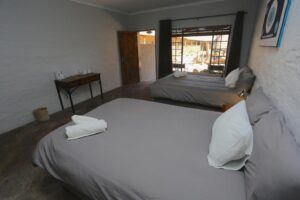
Accommodation is concentrated around Sesriem, ranging from a campsite and simple rooms just outside the park gate (useful for the earliest possible entry) to a range of lodges further out along the road toward Solitaire, and a small number of properties inside the park boundary itself offering the considerable advantage of gate access before the general public. Solitaire, roughly halfway between Sesriem and the coast, is a common overnight stop for travellers approaching from Swakopmund or Windhoek. You can browse Sossusvlei accommodation by price and type on the accommodation hub. For a shortlist grouped by location and style, see our guide to the best accommodation near Sossusvlei.
Where to stay and what to book at Sossusvlei
Almost everything at Sossusvlei is clustered around Sesriem and the Solitaire road. The three properties below sit at very different price points; the map and availability search cover the whole Sesriem area, including the lodges inside the park boundary.
Places to stay near Sossusvlei
Solitaire Roadhouse
Solitaire is a fuel stop, a bakery and a scatter of buildings at the junction of the C14 and C19, and it has become…
Price Guide: N$2,663
View Property DetailsGondwana Namib Desert Lodge
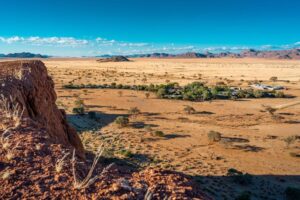
Gondwana Namib Desert Lodge is built against a wall of fossilised dunes north of Sesriem, and that backdrop is the…
Price Guide: N$5,084
View Property DetailsThe Desert Grace
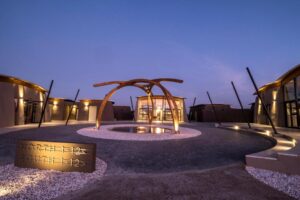
The Desert Grace sits on the corridor between Solitaire and the Sesriem gate, and it is the most deliberately…
Price Guide: N$11,860
View Property Details
Check live availabilityBrowse all Sossusvlei accommodation
Tours and activities in Sossusvlei
Sossusvlei Budget Camping Safari – 3 Days
Travel overland from Windhoek to Swakopmund on this 3-day Sossusvlei camping safari through the Namib Desert.
View Tour Details3-Day Sossusvlei and Deadvlei Shared Desert Tour from Windhoek
A shared-group Deadvlei tour from Windhoek, running directly to Sossusvlei without a coastal detour, with two…
View Tour DetailsSossusvlei Private Guided Tour – 3 Days
Visit Dune 45, Deadvlei and Sesriem Canyon on this private 3-day Sossusvlei tour with meals and park fees included.
View Tour Details


See all Sossusvlei tours and activities
Some booking links are affiliate links. We may earn a commission at no extra cost to you. See our affiliate disclosure.
Suggested length of stay
Most visitors spend one to two nights at Sesriem, allowing a single early morning for Sossusvlei, Deadvlei and Dune 45, with a second morning for Sesriem Canyon or a further dune walk if time allows. Photographers or hikers wanting to climb Big Daddy or explore further into the dune sea often prefer two full mornings rather than one. Travellers combining Sossusvlei with a long self-drive circuit sometimes compress the visit into a single dawn excursion before continuing toward Swakopmund or the south, though this leaves little room for delays and means missing Sesriem Canyon altogether.
Nearby destinations
Sossusvlei sits within the wider Sossusvlei and Namib Desert region and forms a natural link between the coast and the south.
Solitaire
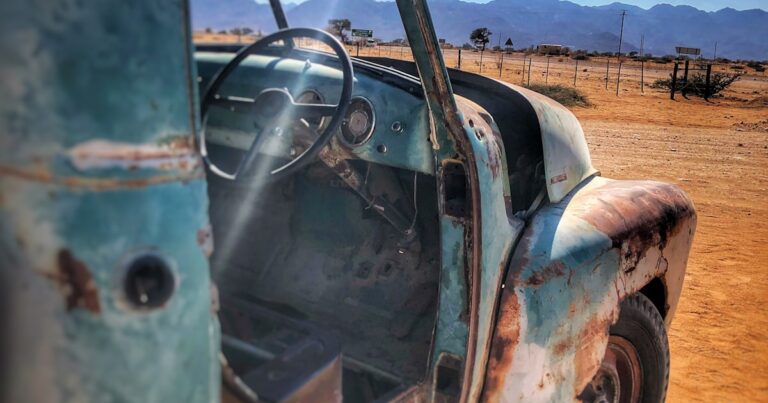
The small crossroads settlement between Sossusvlei and the coast, known for its bakery and old car wrecks.

Walvis Bay
The coastal link north of Solitaire, with its lagoon, dunes and harbour.

Self-Drive Namibia
How Sossusvlei fits into a wider self-drive circuit around the country.
Frequently asked questions
Do I need a 4×4 to see Sossusvlei?
You need a 4×4, or the shuttle service, only for the final few kilometres of soft sand beyond the 2×4 car park. The 60-kilometre road from Sesriem to that car park is tarred and suitable for any vehicle.
What is the difference between Sossusvlei and Deadvlei?
Sossusvlei is the main clay pan reached at the end of the access road; Deadvlei is a separate, smaller pan a short walk away, known for its dead camel-thorn trees and often considered the more photogenic of the two.
Should I climb Dune 45 or Big Daddy?
Both are optional. Dune 45 is a shorter, more accessible climb popular at sunrise; Big Daddy near Deadvlei is taller and more strenuous. Neither is necessary to enjoy the landscape, which is spectacular from ground level too.
Last reviewed: July 2026.
Can I fly over Sossusvlei instead of driving?
Scenic flights over the dune sea are offered by operators based around Sesriem and Swakopmund and give a very different perspective on the scale of the dune system, though they are a costly addition rather than a substitute for the ground-level experience, and most visitors treat a flight as a bonus rather than the main event.
Is Sossusvlei suitable for young children or older travellers?
The main viewing areas at Sossusvlei and Deadvlei are reachable without climbing a dune, so the destination is generally manageable for a wide range of ages and fitness levels; it is the optional dune climbs, the heat, and the soft-sand walking rather than the core sightseeing that require reasonable fitness and caution.
Planning the rest of your trip?
See how Sossusvlei fits into a full Namibia route, and what to prepare before you drive there.
Further reading: Sossusvlei vs Deadvlei sets out what travellers most often confuse about these two sites and how to fit both into one morning.