
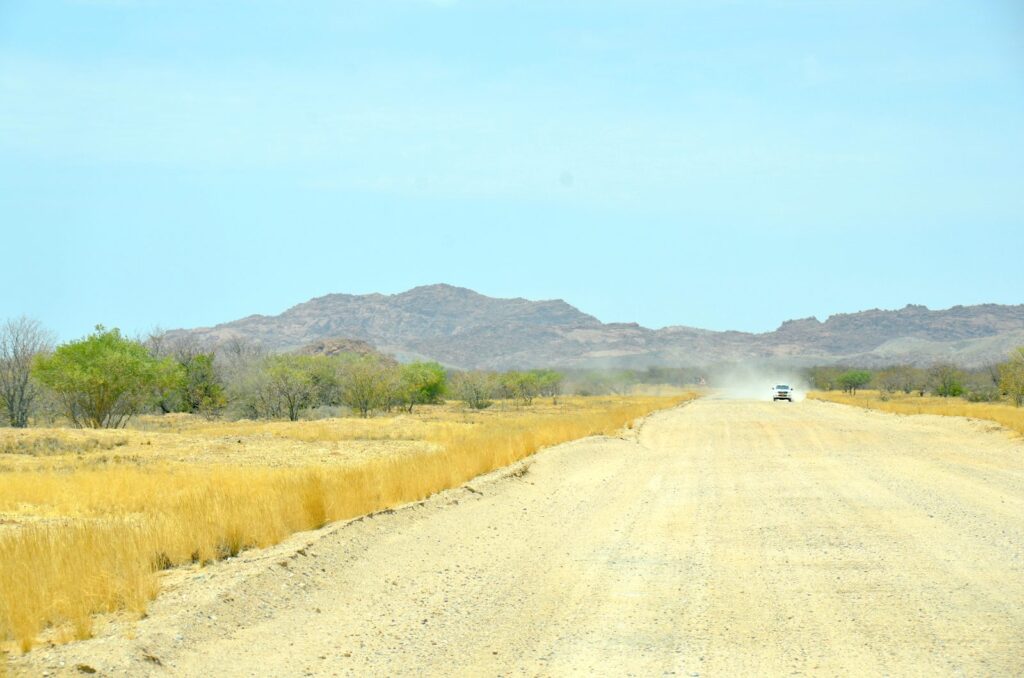
Damaraland and Kaokoland sit next to each other in Namibia’s north-west and get mentioned in the same breath often enough that travellers assume they are variations on one another. They are not. The gap between them — in road difficulty, in what a day actually involves, and in how much margin for error you have — is one of the biggest steps up anywhere in Namibian travel.
Getting this distinction right before you book a vehicle is worth more than almost any other planning decision in the north-west.
The short version
Damaraland is accessible, spectacular, and works on a normal self-drive itinerary. Rock art, desert-adapted wildlife, extraordinary geology, and roads that a high-clearance vehicle handles comfortably.
Kaokoland is genuinely remote. Rough tracks, long distances between fuel and help, sparse traffic, and a strong case for a proper 4×4 and two vehicles. The reward is a part of Africa that very few travellers reach.
Roads and vehicles — the decisive difference
In Damaraland, the main routes are gravel C roads, generally well graded. The approaches to Twyfelfontein, the Brandberg and the Petrified Forest involve some rougher D-road sections where higher clearance earns its place, but this is normal Namibian gravel driving. A high-clearance two-wheel-drive vehicle copes.
In Kaokoland, particularly north and west of Opuwo, the tracks include rock, deep sand and river crossings. Four-wheel drive stops being a comfort upgrade and becomes the right tool. Travelling in two vehicles is common practice rather than paranoia, because passing traffic can be very thin and self-recovery is not always possible.
Our 4×4 vs 2WD in Namibia guide works through exactly where that line falls.
Fuel, services and margin for error
Damaraland has workable anchors — Khorixas, Uis and Kamanjab all provide fuel and basic supplies, and the gaps between them are manageable.
Kaokoland is a different calculation. Opuwo is the last substantial supply point for a large area, and beyond it you are planning fuel by station and carrying your own water and spares. See fuel planning in Namibia before committing to a Kunene route.
What you actually see
Damaraland delivers on landscape and on a specific kind of wildlife. The rock engravings at Twyfelfontein are a UNESCO-listed site and among the most significant rock-art concentrations in Africa. The Brandberg holds the White Lady painting. And the region supports desert-adapted elephant and, in the Palmwag area, black rhino — animals that have adjusted to an environment that should not support them.
Kaokoland is about the Kunene River, the far north-west, and the Himba communities who live there. Epupa Falls is the set-piece, and it is genuinely worth the drive. The landscape is emptier and harder than Damaraland’s and the sense of remoteness is the substance of the trip rather than a side effect.
Cultural travel — a note worth reading
Kaokoland is strongly associated with Himba communities, and visits to settlements are a common part of organised travel there. Approach this carefully. Arrange visits through the community or a reputable local guide rather than arriving unannounced, ask before photographing people, and treat a settlement as somewhere people live rather than as an attraction.
The same principle applies to the Damara and other communities in Damaraland. Handled well this is one of the most valuable parts of a north-western trip; handled badly it is intrusive.
Time required
Damaraland fits into a standard itinerary. Two to three nights covers Twyfelfontein, the Brandberg area and a proper look at the landscape, and it slots naturally between the coast and Etosha.
Kaokoland does not compress. Realistically you need the better part of a week to reach Epupa and the Kunene and come back without spending the entire time driving, which is why it generally belongs in a three-week trip rather than a fortnight. Our 7, 10 or 14 days guide sets out where each fits.
First trip to Namibia?
Take Damaraland. It gives you most of what people imagine when they picture the Namibian north-west — rock art, desert elephant, extraordinary geology — without demanding a specialist vehicle, a convoy or a week of your itinerary.
Kaokoland is a superb second or third Namibian trip, or a first one if you are an experienced remote-area self-driver who is going specifically for it. It is not a good place to discover that you are less comfortable with rough tracks than you thought.
Where to stay in each region
Both regions have thin, widely spaced accommodation, and neither rewards arriving without a booking. A short selection is shown for each, with a separate availability search per region.
Damaraland
iGowati Country Hotel
A dependable, affordable town hotel in Khorixas, ideal as a convenient overnight stop and supply point on a…
Price Guide: N$1,116
View Property DetailsMadisa Camp
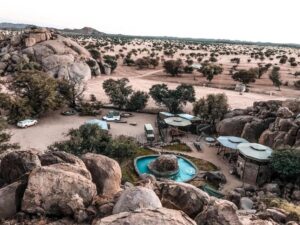
An inventive, family-run camp of safari tents and campsites set among boulders between Twyfelfontein and the…
Price Guide: N$2,800
View Property DetailsTwyfelfontein Country Lodge
A comfortable, mid-range thatched lodge set against dramatic red sandstone koppies, minutes from the UNESCO-listed…
Price Guide: N$7,260
View Property Details


Check Damaraland availabilityBrowse all Damaraland accommodation
Kaokoland
Khowarib Lodge
Tented lodge above the Hoanib River gorge at Khowarib, on the C43 between Sesfontein and Palmwag — desert-elephant…
Price Guide: N$2,150
View Property DetailsOpuwo Country Lodge
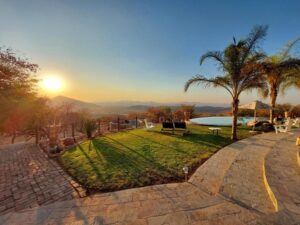
Hilltop lodge above Opuwo with air-conditioned rooms, a restaurant and wide Kaokoland views — the main comfortable…
Price Guide: N$3,190
View Property DetailsEpupa Falls Lodge
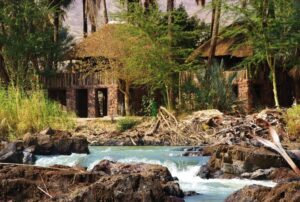
Riverside lodge a few hundred metres from Epupa Falls, with half-board rooms, camping lots and palm-shaded frontage…
Price Guide: N$5,600
View Property Details

Check Kaokoland availabilityBrowse all Kaokoland accommodation
Some booking links are affiliate links. We may earn a commission at no extra cost to you. See our affiliate disclosure.
Accommodation
Damaraland has a decent spread, from campsites to serious lodges: see Damaraland accommodation. Kaokoland’s supply is genuinely thin and concentrated around Opuwo, Sesfontein and Epupa — see Kaokoland and Kunene accommodation and book well ahead in the dry season.
Frequently asked questions
Do I need a 4×4 for Damaraland?
Not usually. High clearance is genuinely useful on the rougher D roads, but the main routes are manageable gravel. Kaokoland is where true 4×4 becomes necessary.
Is Kaokoland suitable for a first Namibia trip?
Generally no, unless you are an experienced remote-area driver going specifically for it. Damaraland gives a similar flavour with far less risk and far less time.
How long do I need for each?
Two to three nights for Damaraland. Closer to a week for Kaokoland if you want to reach Epupa and the Kunene properly.
Should I travel in two vehicles?
For remote Kaokoland tracks it is common and sensible. For Damaraland it is unnecessary.