
Kaokoland and Kunene
Namibia’s most remote and rugged north-west, home to the Himba people
Destinations › Kaokoland and Kunene

Kaokoland and Kunene is Namibia’s most remote and demanding travel region, a vast, mountainous wilderness in the far north-west where tarred roads give way entirely to rough tracks, mobile signal disappears for days at a time, and the Himba people continue a semi-nomadic pastoral way of life little changed in its essentials for generations. This is not a region for casual detours: it requires serious vehicle preparation, self-sufficiency and, for most visitors, an experienced guide or operator. For those equipped for it, the reward is landscapes and cultural encounters found nowhere else in southern Africa.
Kaokoland and Kunene at a glance
- Region: far north-western Namibia, along the Kunene River and Angola border
- Main settlements: Opuwo, Sesfontein, Puros, Epupa Falls
- Known for: Himba communities, Epupa Falls, the remote Marienfluss and Hartmann valleys, Van Zyl’s Pass
- Suits: experienced, well-prepared 4×4 self-drivers or travellers using a specialist guided operator
- Requirements: high-clearance 4×4, full self-sufficiency for fuel/water/spares, satellite communication strongly advised
Geographic setting
This region occupies Namibia’s far north-west corner, bordered by the Kunene River and Angola to the north and the Skeleton Coast to the west. It is dominated by rugged mountain ranges, deep valleys and dry riverbeds, with the Kunene River providing the only reliable perennial water source across much of the area.
Landscape and climate
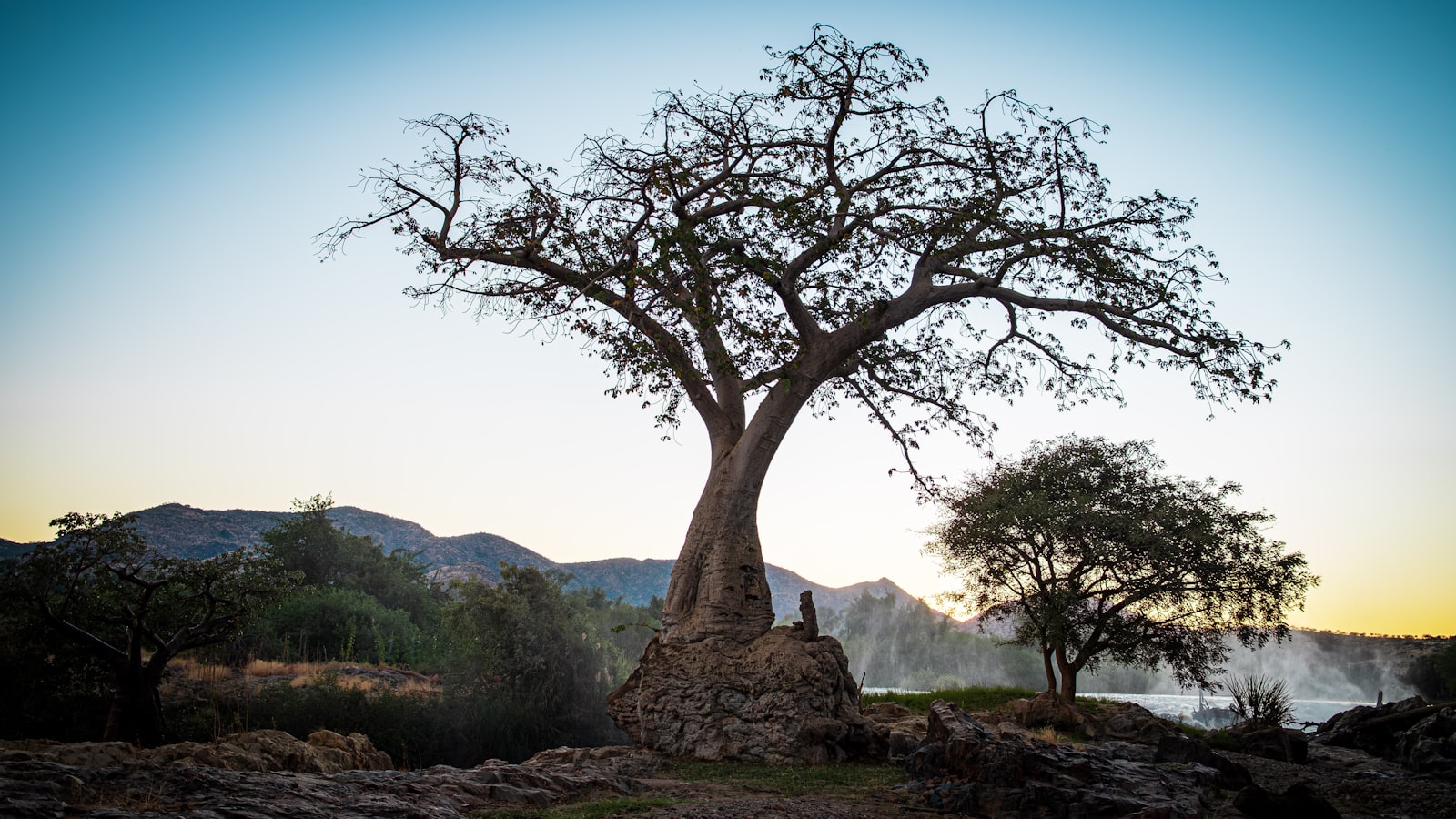
Kaokoland’s terrain ranges from mopane scrubland around Opuwo to the stark, mountainous “moonscape” of the Marienfluss and Hartmann valleys further north-west, among the most remote landscapes in Namibia. Rainfall is very low and unpredictable, and temperatures can swing dramatically between hot days and cold nights, particularly in winter (May to August). The Kunene River corridor, by contrast, supports lush riverine vegetation, including large baobabs, in an otherwise arid landscape.
Historical context
Like Damaraland, Kaokoland was designated a “homeland” for Himba and Herero communities under South African apartheid-era administration, restricting movement and formalising the region’s isolation for decades. This isolation, while rooted in an unjust system, has also meant that Himba pastoral life continued with less external disruption than in many other parts of Namibia, though this should not be romanticised: communities here have made active, ongoing choices about how much to engage with tourism, education and the modern Namibian economy, rather than being frozen in an unchanging past.
Cultural context
The Himba, a semi-nomadic Herero-related people, are the region’s best-known community, recognisable by the otjize paste of butterfat and ochre traditionally applied to skin and hair. Many Himba families maintain a largely pastoral, cattle-based way of life, though individual choices vary considerably, and increasing numbers of Himba people also live and work in Opuwo and beyond. Visitors should be aware that some village visits are organised specifically for tourism and operate on a commercial, consent-based basis, while other communities are not interested in visitors at all; approaching any homestead uninvited is not appropriate, and photographs of individuals should always be requested first, not assumed.
Why visit
Kaokoland offers landscapes and a degree of genuine remoteness that no other part of Namibia can match, along with the chance to meet Himba communities respectfully through established, consent-based tourism arrangements. It suits experienced overlanders and self-drive adventurers specifically seeking this kind of challenge, rather than travellers looking to add “one more stop” to a standard itinerary.
Main towns and settlements
Opuwo, the regional capital, is the only town of any size in Kaokoland and the natural place to fuel up, restock and arrange a guide before heading further into the region; it is also where Himba, Herero and other communities visibly intersect in daily life. Sesfontein, further north, is a small oasis settlement built around a restored German colonial fort (now a lodge) and marks the practical gateway to the more remote parts of Kaokoland. Puros, on the Hoarusib River, is a small community conservancy settlement known for desert-adapted elephant sightings along the riverbed.
Towns and places in this region
Individual destination guides cover each place in more depth, with photography where available.

Opuwo. The regional centre and main supply point for Kaokoland.
Explore »Epupa Falls. A dramatic waterfall on the Kunene River, on the Angolan border.
Explore »Sesfontein. A small remote settlement and route junction into Kaokoland.
Explore »Ruacana sits where the Kunene turns west to form the Angolan border. Its waterfall can be extraordinary at high water and close to dry the rest of the time, and the town is the practical hinge between the Kunene and the north-central region.
Natural attractions
Epupa Falls, on the Kunene River at the Angola border, is a broad series of cascades surrounded by dramatic baobabs, one of the most scenic spots in the region and a popular base for a night or two. The Marienfluss and Hartmann Valley, far to the north-west, are remote, otherworldly valleys known for their stark beauty, including scattered “fairy circle” formations, and are reached only by serious 4×4 travel. The Hoanib Valley is a dry riverbed corridor known for desert-adapted elephant and, occasionally, lion. Van Zyl’s Pass is a legendarily difficult one-way 4×4 descent linking the Marienfluss area to the rest of Kaokoland, attempted only by experienced, well-equipped drivers, ideally in convoy.
Suggested self-drive routes
A common route runs from Damaraland via Sesfontein to Epupa Falls, allowing a two-night stay before returning via Opuwo. The far more demanding Marienfluss/Hartmann Valley/Van Zyl’s Pass circuit is a multi-day expedition-style route recommended only for well-prepared, experienced 4×4 travellers, often in convoy with a second vehicle, and is not a route to attempt on a first Namibia trip.
Typical route connections
The C43 links Damaraland to Sesfontein and on toward Opuwo, while the C41 connects Opuwo south-east toward Kamanjab and Etosha. The C46 links Opuwo to Ruacana and North-Central Namibia in the east.
Best time to visit
The dry season (May to October) is by far the easier and safer time to travel here, with more predictable river crossings and road conditions. The wet season can render some tracks impassable and is generally not recommended for independent travel in this region.
Suggested length of stay
A visit focused on Epupa Falls and Opuwo can be managed in three to four days from Damaraland and back. A fuller exploration including the Marienfluss and Van Zyl’s Pass requires a week or more and should only be undertaken with appropriate experience or a specialist guide.
Accommodation context
Opuwo has a small number of lodges and guesthouses. Epupa Falls has a handful of campsites and lodges overlooking the river. Beyond these points, accommodation is limited to basic community campsites or full self-sufficient camping, and advance planning is essential.
Supply in the Kunene is genuinely limited and concentrated around Opuwo, Sesfontein and the Epupa area. See our Kaokoland and Kunene accommodation listings, and book well ahead in the dry season.
Where to stay in Kaokoland and the Kunene
Beds in this region are concentrated at Opuwo, along the Hoanib and Hoarusib, and at Epupa Falls — with long distances between them. Booking ahead is close to essential. These three span a campsite to a river lodge.
Places to stay near Kaokoland
Opuwo Country Lodge Campsite
Serviced camping pitches on the Opuwo Country Lodge grounds — bring your own tent, with lodge facilities a short…
Price Guide: N$660
View Property DetailsKhowarib Lodge
Tented lodge above the Hoanib River gorge at Khowarib, on the C43 between Sesfontein and Palmwag — desert-elephant…
Price Guide: N$2,150
View Property DetailsEpupa Falls Lodge
Riverside lodge a few hundred metres from Epupa Falls, with half-board rooms, camping lots and palm-shaded frontage…
Price Guide: N$5,600
View Property Details

Check live availabilityBrowse all Kaokoland accommodation
Some booking links are affiliate links. We may earn a commission at no extra cost to you. See our affiliate disclosure.
Vehicle requirements and remote travel preparation
A high-clearance 4×4 with good ground clearance and low-range gearing is essential beyond Opuwo and Sesfontein, along with spare tyres, recovery equipment, and sufficient fuel, food and water for several days of full self-sufficiency, since fuel and supplies cannot be relied upon once away from the main settlements. Mobile phone coverage is largely absent throughout the remoter parts of the region, and a satellite phone or satellite messenger device is strongly advised. Travelling in convoy with a second vehicle is recommended for the more difficult routes, including Van Zyl’s Pass and the Marienfluss.
Ethical visitation
Himba and other communities in this region are not a tourist attraction to be observed passively; any village visit should be arranged through an established, consent-based operator or guide who has a genuine ongoing relationship with the community concerned. Always ask before photographing people, respect requests not to enter certain areas, and consider that payment for photographs or craft purchases, where customary, should go directly and fairly to the individuals involved.
Nearby regions
Kaokoland and Kunene borders Damaraland to the south via Sesfontein, and North-Central Namibia to the east via Ruacana.
Existing and future destination guides
No individual destination guides for Opuwo, Epupa Falls or other Kaokoland settlements are published yet; this hub page currently provides the only available information. Individual guides may follow in future, though the region’s remoteness and the ethical care required around Himba community visits mean this research will take time to do properly.
Frequently asked questions
Can I visit Kaokoland in a standard rental sedan?
No. A high-clearance 4×4 is essential beyond Opuwo and Sesfontein, and much of the region is unsuitable for any two-wheel-drive vehicle.
Is it appropriate to visit a Himba village?
Yes, if arranged respectfully through an established guide or operator with a genuine relationship with the community, on a consent-based basis. Turning up unannounced at a homestead is not appropriate.
Do I need a guide for this region?
For Opuwo and Epupa Falls, an experienced self-driver can manage independently with proper preparation. For the Marienfluss, Hartmann Valley and Van Zyl’s Pass, a guide or a highly experienced group with satellite communication is strongly recommended.
Last reviewed: July 2026.
Planning a remote north-west route?
Kaokoland connects naturally with Damaraland and the Skeleton Coast. See Destinations and Self-Drive Namibia for preparation guidance.
See sample itinerariesImages: existing Namibia Travel Guide media library (Epupa Falls baobab and Opuwo town photography). Last reviewed: 27 July 2026.
Further reading: the Kunene is one of the few parts of Namibia where vehicle choice and route planning really matter — Namibia self-drive mistakes to avoid is worth reading before you commit to this region.
Deciding between the Kunene and the country to its south? Damaraland vs Kaokoland explains how much harder this region is, and who it suits.