
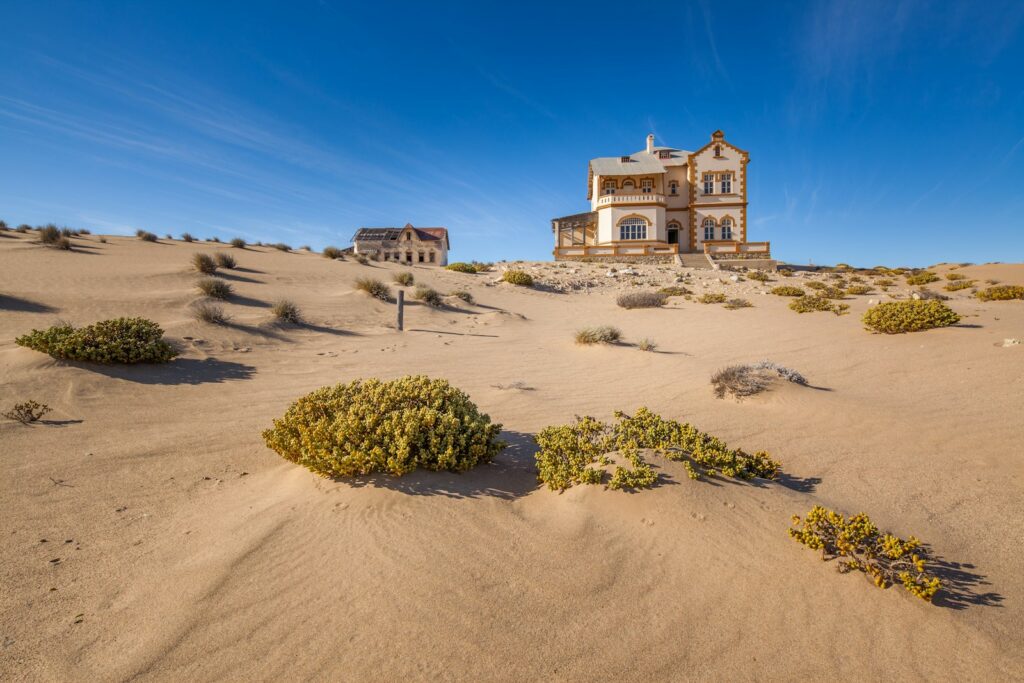
Kolmanskop is an abandoned diamond-mining town in the Namib, a short drive inland from Lüderitz. For roughly forty years it was one of the wealthiest settlements in the territory; it has now stood empty for longer than it was ever occupied, and the desert has been steadily reclaiming it. Sand lies waist-deep through the doorways of houses that once had imported furniture and piped water, and it is that collision — European domestic architecture half-swallowed by dune — that draws most visitors.
Why travellers visit
Kolmanskop is the most-visited single attraction in this part of Namibia, and it earns that on more than novelty. It is a legible place: you can walk through a shop, a hospital, a ballroom and a row of managers’ houses and read the social order of the settlement directly off the buildings. It is also unusually photogenic, and for many travellers the photography is the point. What it is not is a quick roadside stop — it repays an unhurried couple of hours.
The diamond rush, 1908
In 1908 a railway worker named Zacharias Lewala picked up a stone while clearing sand from the line near Lüderitz and showed it to his supervisor, August Stauch. It was a diamond. The find set off a rush, and within months the German colonial administration had declared the surrounding stretch of desert a Sperrgebiet — a prohibited area — closing it to public entry and granting exclusive prospecting rights to a licensed company.
That declaration is the reason Kolmanskop exists in the form it does. Because access was controlled and the deposits were rich and close to the surface, the operation could afford to build a permanent town rather than a camp, and to import almost everything it needed across the desert by rail.
The town at its height
At its peak in the years around and after the First World War, Kolmanskop had a hospital, a school, a ballroom and theatre, a sports hall, a casino, an ice factory and a narrow-gauge railway connecting it to Lüderitz. The houses were built in a German idiom quite unsuited to the Namib and were supplied with fresh water shipped in and distributed by pipe. The hospital was equipped to a standard well beyond what the settlement’s size would suggest.
That prosperity rested on migrant contract labour. The comfortable housing, the ballroom and the ice deliveries were for the European staff and their families; the men who did the physical work of extracting the diamonds were largely contract labourers recruited from the north of the territory, housed separately and under materially worse conditions. Any honest account of Kolmanskop has to hold both of those facts at once, and the site is better understood as an industrial labour settlement than as the romantic ruin it is often photographed as.
Decline and abandonment
Two things ended Kolmanskop. Diamond prices fell sharply after the First World War, and in 1928 far richer deposits were found to the south around the mouth of the Orange River, at what would become Oranjemund. Capital, equipment and people followed the diamonds south. Kolmanskop emptied slowly over the following decades and was finally abandoned in the mid-1950s.
Nothing was demolished. The town was simply left, and the prevailing wind has been moving sand through it ever since.
What you actually see
The site is a scatter of buildings across a low rise, some restored and maintained, most not. The restored buildings — typically the shop, the skittle alley and one or two houses — give you the furnished version. The unrestored houses are the reason people come: rooms where the dune has poured through a window and risen to the height of a door handle, wallpaper still on the walls above it, light coming through empty frames onto sand.
The sand levels are not static. Rooms that were open a few years ago may now be filled, and others have scoured out. Two visitors some seasons apart will not see quite the same place.
Access, permits and guided visits
Kolmanskop sits inside the former Sperrgebiet, and entry is controlled. A permit or guided-tour booking is required, normally arranged in Lüderitz or at the site, and guided tours run on a set schedule for part of the day. Access arrangements, tour times and fees for this and other restricted-area sites do change — confirm the current position locally before you plan a day around it rather than relying on any published figure, including ours.
Photographers wanting to be in the buildings outside normal tour hours are usually handled under a separate arrangement. If that matters to you, ask about it well in advance rather than on the morning.
Getting there from Lüderitz
Kolmanskop lies just off the B4, the tarred road that runs east from Lüderitz across the desert. The turn-off is signposted and the approach is short. No high-clearance or four-wheel-drive vehicle is needed to reach the site itself; an ordinary hire car is fine.
The wider consideration is the drive to Lüderitz, which is long and exposed, with wind-blown sand across the road in places. Our Namibia self-drive mistakes to avoid guide covers the planning errors that most often catch people out on exactly this kind of route, and Namibia driving distances sets out the legs.
How long to allow, and when to go
Two hours is a reasonable minimum and photographers routinely spend longer. Most visitors fold it into a single day based in Lüderitz, combining it with the town’s architecture and a coastal excursion.
Early morning generally gives the most workable light inside the buildings and the calmest conditions; the wind here typically strengthens through the day, and blowing sand is unpleasant to walk in and hard on camera equipment. Season matters less than time of day. Our best time to visit Namibia guide covers the southern coastal pattern.
What to bring, and how to behave on site
Take more water than you expect to need, sun protection and something to keep sand out of your camera. Closed shoes are sensible — there is broken glass and rusted metal in the unrestored buildings. Wind shells earn their place here more than almost anywhere else in the country.
The buildings are fragile and are a heritage site, not a set. Stay off structurally unsound floors and staircases, do not move objects to compose a photograph, and take nothing away — removing anything from the ground inside the former Sperrgebiet is an offence quite apart from the heritage question. Follow your guide’s instructions about which buildings are safe to enter.
Where to stay
There is no accommodation at Kolmanskop. Visitors stay in Lüderitz, a short drive away, which has hotels and guesthouses in the historic centre and along the waterfront. See our Lüderitz accommodation listings, or browse the Namibia accommodation hub.
Where to stay for Kolmanskop
Kolmanskop has no accommodation of its own — it is a 15-minute drive from Lüderitz, which is where every visitor stays. Rooms in town are limited, so book before you commit to the drive south.
Places to stay near Lüderitz
Windy Dunes Self-Catering Accommodation
Windy Dunes Self-Catering Accommodation is a small independent apartment on Erf 739 in Lüderitz, about 0.8 km from…
Price Guide: N$880–N$1,056
View Property DetailsShark Island Guesthouse
Shark Island Guesthouse sits on Insel, right on the water in Lüderitz, about 1.1 km from the town centre, giving…
Price Guide: N$1,200
View Property DetailsLüderitz Nest Hotel
Lüderitz Nest Hotel sits on Diaz Street directly on the bay in Lüderitz, a colonial-era port town on Namibia's…
Price Guide: N$4,400–N$4,700
View Property Details


Check live availabilityBrowse all Lüderitz accommodation
Some booking links are affiliate links. We may earn a commission at no extra cost to you. See our affiliate disclosure.
Nearby, and where to go next
Lüderitz itself is the obvious pairing: its colonial-era architecture, harbour and the difficult history of Shark Island are all covered on the Lüderitz guide, along with coastal excursions to Diaz Point.
Heading back inland, the natural onward legs are Aus and the desert-horse country on the way east, then Keetmanshoop and the quiver trees, or south to the Fish River Canyon. The full sequence is set out in the Southern Namibia region guide, and our Namibia itineraries show how the southern loop fits into a longer trip.
Frequently asked questions
Do I need a permit to visit Kolmanskop?
Yes. Kolmanskop lies within the former Sperrgebiet and entry requires a permit or a booked guided tour, normally arranged in Lüderitz or at the site. Confirm current arrangements locally, since access rules for restricted-area sites can change.
How long does a visit take?
Allow around two hours for a guided tour and a walk through the unrestored buildings. Photographers commonly want longer, and often want to be there earlier than the standard tour.
Do I need a 4×4?
No. Kolmanskop is a short, signposted turn-off from the tarred B4 and an ordinary two-wheel-drive hire car reaches it without difficulty.
Can I visit Kolmanskop without going to Lüderitz?
Not realistically. There is no accommodation or fuel at the site, and Lüderitz is the only practical base. In practice the two are a single destination.