
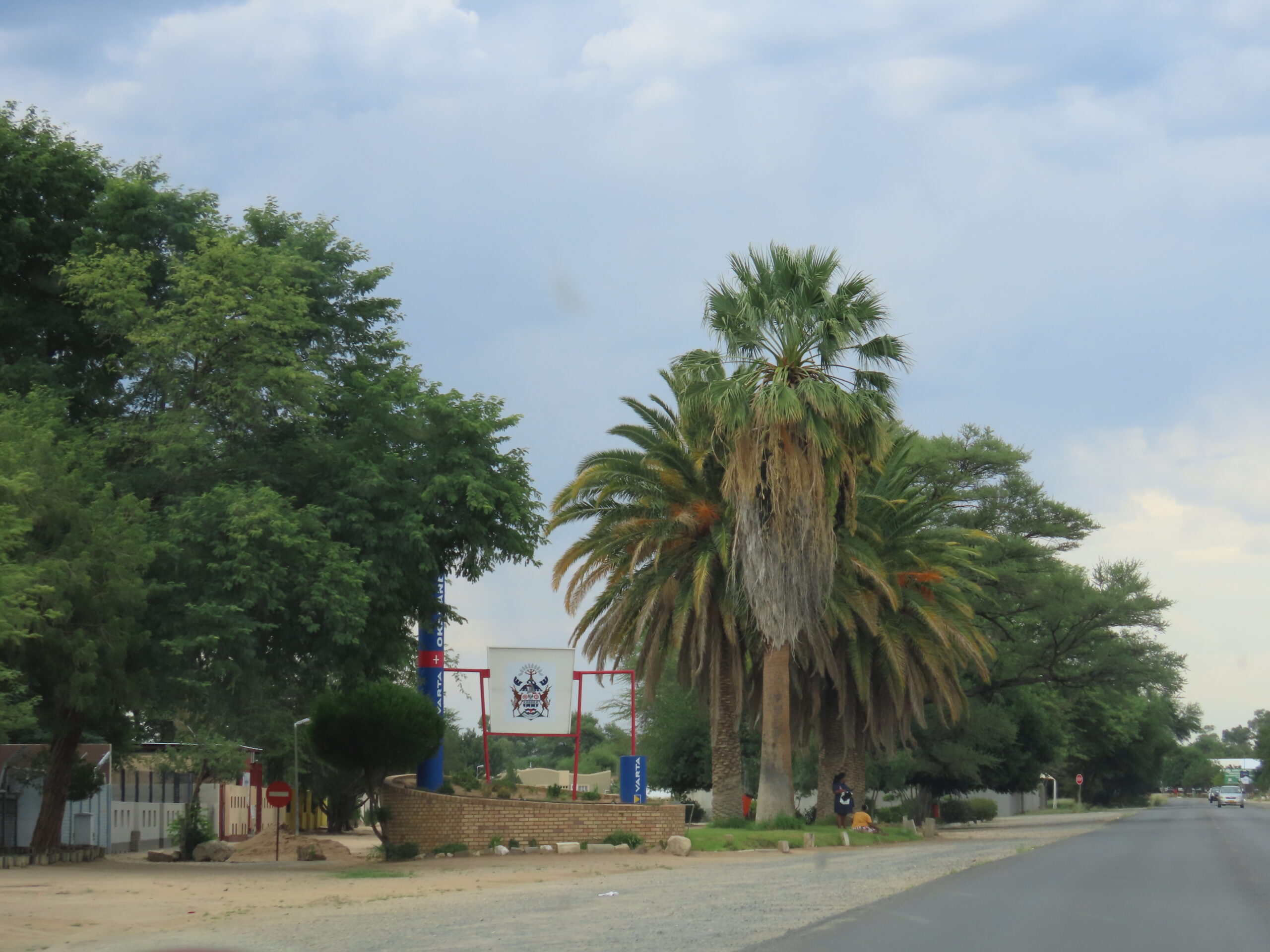
Okahandja
A historic Herero and Nama town on the B1, known for its jacaranda-lined streets, woodcarvers’ market and royal graves.
Okahandja sits astride the B1 highway around 70 km north of Windhoek, at the point where Namibia’s main north-south road crosses the Okahandja River. Known informally as the “Garden Town” for its jacaranda-lined streets, it is both a working farming and transport centre and one of the most historically significant towns in the country, particularly for Herero and Nama communities, whose annual commemorative gatherings at the royal graves remain a defining feature of the town’s identity.
Okahandja at a glance
Geographic setting
Okahandja lies in a gently undulating landscape of camelthorn savanna typical of central Namibia, drained by the usually dry Okahandja River. The town sits at an important crossroads: the B1 running north-south between Windhoek and Otjiwarongo, and the B2 branching west towards Karibib, Swakopmund and Walvis Bay. This position has made it a natural staging point for travel in almost every direction since well before independence.
Historical context
Okahandja was an important Herero settlement and the seat of Herero leadership through the nineteenth century, and it was here that conflict between Herero and Nama forces, and later between Herero communities and German colonial troops, shaped much of the town’s history. Rhenish missionaries established a station in the area in the 1840s, and the German colonial administration later built a fort and garrison town around the same site.
Okahandja was a focal point during the Herero-German war of 1904, part of the wider colonial conflict in which German forces killed a large proportion of the Herero population in what is now widely recognised as genocide; the town’s royal cemetery and its commemorative gatherings are directly connected to this history and should be understood in that context, not simply as a cultural curiosity.

A town shaped by its history
Okahandja’s streets and church buildings, including the Gereformeerde Kerk pictured here, reflect the town’s long and layered history as a missionary station, colonial administrative centre and, above all, a place of deep significance to the Herero and Nama communities.
Photo: Ventereav90, CC BY-SA 4.0, via Wikimedia Commons.
Present-day character
Today Okahandja functions as a busy agricultural and transport town serving the surrounding cattle and game farms of Otjozondjupa. It has a functioning town centre with banks, supermarkets, fuel stations and schools, and it remains an important cultural centre for Herero and Nama communities, most visibly during annual commemorative events held at the royal graves.
Why visit
Most visitors encounter Okahandja as a stop on the drive north from Windhoek towards Etosha, Damaraland or the coast, but the town rewards a short pause in its own right: a chance to see the royal graves and understand their significance, to visit the woodcarvers’ market, and to detour to the historic mission station and hot springs at Gross Barmen.
Main sights and experiences
The Herero and Nama royal graves, on a hill overlooking the town, are the resting place of several Herero chiefs, including Samuel Maharero, and are the focus of annual commemorative gatherings, most notably Maharero Day in August, when Herero traditional riders and communities from across Namibia converge on the town in ceremonial dress. Visitors should treat these sites and events with the same respect due to any war memorial and burial ground, and should be aware that access during commemorations is primarily for participating communities rather than casual sightseeing.
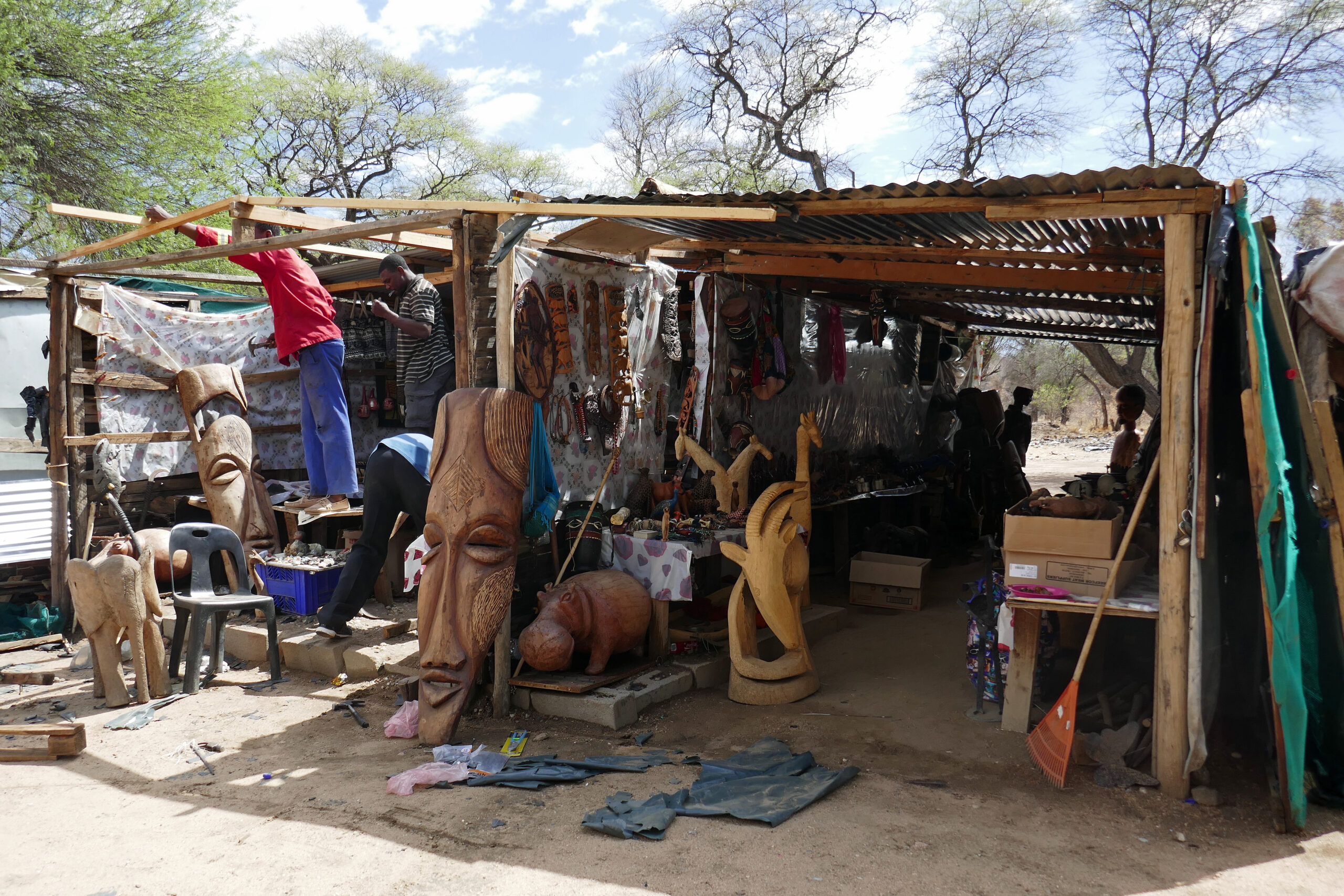
Okahandja’s woodcarvers’ market, strung along the B1 at the southern entrance to town, is one of the largest in Namibia, with carvers producing everything from small animal figures to large furniture pieces, much of it in local hardwoods and imported woods from further north. It is a genuine working craft market and a significant source of income for many carving families, rather than merely a roadside curiosity, and buying directly supports the artisans involved.
The roadside woodcarvers’ market
Okahandja’s woodcarvers’ market, strung out along the B1 through town, is one of Namibia’s best-known craft stops, with stalls selling carved wooden animals, masks and other curios made by local artisans.
Photo: Ji-Elle, CC BY-SA 4.0, via Wikimedia Commons.
Cultural and historical significance
Okahandja’s role as a centre of Herero identity and memory continues to shape the town today. The Rhenish mission church in the town centre, dating from the German colonial period, is one of the older buildings still in use. Visitors interested in this history are better served by engaging thoughtfully with the royal graves and any available local information than by treating the town’s commemorative culture as a photo opportunity.
Accommodation context
Okahandja has a range of guesthouses and small hotels in and around the town centre, along with guest farms and lodges on the surrounding commercial farmland, and a resort-style hot springs property at nearby Gross Barmen. Most visitors choose accommodation either in town for convenience on the B1, or slightly out of town on a farm setting for a quieter overnight stop. Travellers heading onward to the Waterberg Plateau can also browse lodges covering that area in our Waterberg accommodation guide.
Where to stay near Okahandja
Okahandja is 70 km from Windhoek and most people pass through rather than sleep here. The guest farms and lodges on the surrounding B1 and C33 are the realistic options; live availability covers them.
Check live availabilityBrowse all Okahandja accommodation
Some booking links are affiliate links. We may earn a commission at no extra cost to you. See our affiliate disclosure.
Food, shopping, fuel and supplies
As a district service centre, Okahandja has supermarkets, bakeries, banks with ATMs, pharmacies and several fuel stations along the B1, making it a sensible place to fill up and restock before heading further north or west, particularly for travellers heading towards Etosha, Damaraland or the coast where facilities become more widely spaced.
How to get there
Okahandja is reached via the tarred B1 from Windhoek, roughly an hour’s drive, and is also served by the TransNamib railway line linking Windhoek to the north. Most independent visitors arrive by self-drive car or rental vehicle rather than public transport.
Getting around
The town centre and woodcarvers’ market are easily explored on foot or by a short drive; a private vehicle is needed to reach Gross Barmen and Von Bach Dam, both a short distance outside town.
Best time to visit
Okahandja can be visited year-round as a stop on a self-drive itinerary. Travellers with a specific interest in Herero cultural life may wish to time a visit around the annual August commemorations, while those simply passing through can call in at any time of year.
Suggested length of stay
Most travellers spend a few hours here as a stop between Windhoek and points north, though an overnight stay allows time for the royal graves, the woodcarvers’ market and a side trip to Gross Barmen or Von Bach Dam.
Day trips and nearby attractions
Gross Barmen, around 24 km west of town, is a historic Rhenish mission station turned hot springs resort, with warm mineral pools fed by an artesian spring. Von Bach Dam Recreation Resort, just south of Okahandja, offers a reservoir setting popular for birdwatching, fishing and picnicking, and is a pleasant short detour for travellers with their own vehicle.
Road and vehicle considerations
The B1 through Okahandja is a well-maintained tarred road suitable for any vehicle. Roads to Gross Barmen and Von Bach Dam are gravel, manageable in a standard car at moderate speed but requiring more care after rain.
Safety and practical considerations
As with any Namibian town, ordinary town-centre precautions apply: keep valuables out of sight in parked vehicles and take care around the busy B1 junction, particularly with livestock and pedestrians near the roadside market.
Responsible travel guidance
Buy carvings directly from makers at the market rather than from unrelated resellers where possible, and treat the royal graves and any commemorative gathering with the same quiet respect due to a war memorial, asking permission before photographing people or ceremonies.
Nearby destinations
Okahandja connects naturally with Windhoek to the south, with the wider Waterberg and Otjozondjupa region it belongs to, and with Omaruru and the Erongo region to the west via the B2, as well as onward north along the B1 towards Otjiwarongo and Etosha.
Windhoek. Namibia’s capital, around 70 km south, with onward flight and self-drive connections.
Waterberg and Otjozondjupa. The wider region Okahandja belongs to, including the Waterberg Plateau.
Waterberg Plateau. A striking sandstone plateau known for rhino and other conservation work.
Omaruru. A quiet Erongo town reached via the B2, popular for art and nearby conservancies.
Frequently asked questions
Is Okahandja worth stopping at on the drive north from Windhoek?
Yes, particularly for the woodcarvers’ market and, for those interested in Namibian history, the Herero and Nama royal graves.
What is Maharero Day?
It is an annual Herero commemoration held in August at Okahandja’s royal graves, honouring Herero chiefs including Samuel Maharero, and forms part of the town’s connection to the history of the Herero-German war.
Can I visit Gross Barmen from Okahandja as a day trip?
Yes, it is a short drive of around 24 km on gravel road and is easily combined with a stop in Okahandja itself.
Related guides: Waterberg and Otjozondjupa, Windhoek and Central Namibia, Erongo Inland.
Last reviewed: 23 July 2026.
Planning a stop in Okahandja?
See the wider Waterberg and Otjozondjupa region, build a self-drive route north from Windhoek, or check the practical planning guides before you go.
Waterberg and Otjozondjupa hub Self-Drive Namibia guide Itineraries Travel PlanningWhere to stay near Okahandja: Okahandja sits close to Windhoek, and most visitors passing through find the widest choice of accommodation there. Browse accommodation in Windhoek for options a short drive from town.