
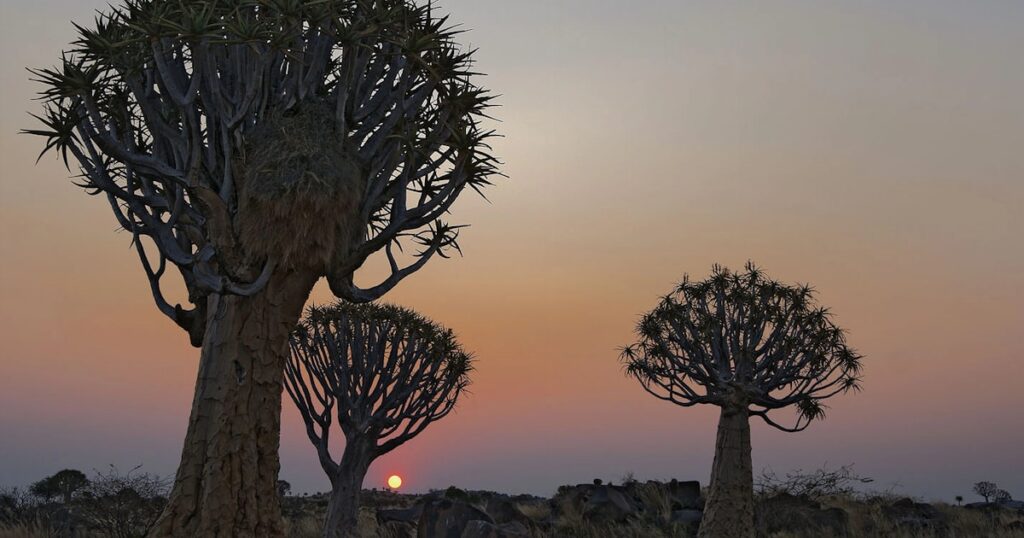
The Quiver Tree Forest is one of those places that photographs so well it can arrive slightly diminished — you have seen the silhouettes against a burning sky before you get there. It survives the expectation. About 250 quiver trees stand on a rocky rise on Gariganus farm, roughly 14 kilometres north-east of Keetmanshoop on the road to Koës, and the reason it works is that the trees are genuinely strange: fat, pale, smooth-barked, branching in forked pairs, standing in a landscape that supports almost nothing else of their size.
What a quiver tree actually is
It is not a tree in the ordinary sense. Aloidendron dichotomum is a tree aloe — a succulent that has taken a tree’s shape. The trunk is soft and fibrous rather than woody, the bark peels in pale golden flakes with edges sharp enough to cut, and the crown branches by splitting in two again and again, which is what dichotomum refers to. The tallest specimens here are two to three centuries old.
The name comes from the San, who traditionally hollowed the light, fibrous branches to make quivers for their arrows. That use is the origin of both the English and Afrikaans names, and it is worth knowing before you visit — it turns the trees from scenery into something with a human history attached.
Why this particular stand matters
Quiver trees grow across a wide belt of southern Namibia and the Northern Cape, usually scattered thinly. A concentration of 250 in one place is unusual enough that it was declared a national monument in 1995. The setting helps: they grow directly out of dolerite rubble on a low ridge, so the ground falls away and you can photograph individual trees against open sky rather than against other trees.
There is also a harder reason to see it now. The species is widely studied as an indicator of climate stress, and populations toward the northern, hotter end of its range have been declining. This forest is at the healthier southern end, but the trees are slow-growing and the stand is not something that regenerates quickly.
Giant’s Playground
On the same farm, a short drive from the trees, is Giant’s Playground — a field of dolerite boulders weathered into stacked columns and balanced piles that look deliberately arranged. The rock is the same intrusion that the quiver trees are rooted in; what differs is how it has weathered.
The two are almost always visited together and are covered by the same farm entry, which is why we treat them as one destination rather than two. Allow extra time for it: the walking route through the boulders is short but genuinely maze-like, and it is easy to lose your sense of direction among rocks that all look similar. Follow the marked route and keep track of where you came in.
Getting there
The turn-off is on the C17 towards Koës, a short and well-signposted run out of Keetmanshoop. The farm track is gravel but undemanding, and an ordinary two-wheel-drive car reaches both the forest and Giant’s Playground without difficulty. This is one of the easiest major sights in Namibia to reach.
Access is through the farm, which charges an entry fee and also runs a restcamp. Fees and opening arrangements are set by the farm and do change — confirm the current position on arrival or by phone rather than relying on any published figure.
When to go, and the light
Sunrise and sunset are what people come for, and the reason is structural rather than romantic: the trees have distinctive silhouettes and the low sun puts colour behind them while lighting the pale bark from the side. Midday is the weakest time here — the forms flatten out and the heat is unpleasant.
The forest is also a well-known night-photography subject, because southern Namibia has very little light pollution and the trees give the sky something to sit behind. If that is your reason for coming, stay on the farm rather than driving out from town in the dark.
Season matters less than time of day. Winter nights are cold and clear; summer brings heat and the chance of cloud. Our best time to visit Namibia guide covers the southern pattern.
How long to allow
Two to three hours covers both the forest and Giant’s Playground at a relaxed pace. Photographers routinely want a full evening and the following dawn, which effectively means staying the night nearby.
Looking after the place
The trees are protected and slow to replace. Do not climb them, break the bark, or carve into the trunks — the tissue is soft and damage does not heal over. Stay on the paths where they exist, and take everything out with you. At Giant’s Playground, do not climb on balanced formations; the boulders are heavier and less stable than they look.
Where to stay
Most visitors base themselves in Keetmanshoop, which is close enough for an early start, and there is also a restcamp on the farm itself — the practical choice if you want to be there for both sunset and sunrise without driving in darkness. See our Southern Namibia accommodation listings, or browse the Namibia accommodation hub.
Where to stay for the Quiver Tree Forest
The forest sits on a working farm about 14 km outside Keetmanshoop, and Keetmanshoop is where the beds are. It is also the obvious overnight break between Windhoek and the Fish River Canyon or the border.
Places to stay near Keetmanshoop
Keetmanshoop Self-catering
Budget self-catering rooms in Keetmanshoop with kitchen access — a low-cost overnight on the southern B1 route.
Price Guide: N$805
View Property DetailsQuiver Inn Guesthouse
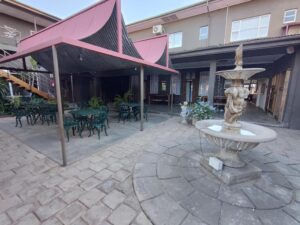
Long-established Keetmanshoop guesthouse with air-conditioned twin and double rooms, a short drive from the quiver…
Price Guide: N$1,500
View Property DetailsBirds Mansions Hotel
Central Keetmanshoop hotel with twin rooms and breakfast included — a conventional hotel option on the southern B1…
Price Guide: N$2,500
View Property Details


Check live availabilityBrowse all Keetmanshoop accommodation
Some booking links are affiliate links. We may earn a commission at no extra cost to you. See our affiliate disclosure.
Nearby, and where to go next
Keetmanshoop is the junction town for the whole south. From here the B1 runs south towards the Fish River Canyon, and west the route runs through Aus to Lüderitz and Kolmanskop.
The Southern Namibia region guide sets out how the southern loop fits together, and our Namibia itineraries show where it belongs in a longer trip. If you are driving down from the centre, driving in Namibia covers the road conditions on the way.
Frequently asked questions
How far is the Quiver Tree Forest from Keetmanshoop?
About 14 kilometres north-east, on the C17 towards Koës. It is a short, signposted drive on gravel and needs no special vehicle.
Can I visit the Quiver Tree Forest and Giant’s Playground together?
Yes — they are on the same farm and are normally covered by the same entry. Together they make a comfortable half-day.
When is the best time of day to visit?
Sunrise or sunset. The trees are photographed for their silhouettes, and low light is what gives them shape. Midday is hot and visually flat.
Do I need a 4×4?
No. The farm track is gravel but straightforward, and an ordinary hire car manages it easily.
How old are the trees?
The tallest specimens are two to three centuries old. Quiver trees grow very slowly, which is part of why the stand is protected.